

This essay contains spoilers for Backrooms (2026) and Obsession (2026)
Released less than one month apart, Kane Parsons' Backrooms (2026) and Curry Barker's Obsession (2026) have exploded in popularity, provoking discussions about the ways both dissect aspects of toxic masculinity. They each tell stories of men—Clark and Bear—wallowing in their own misery and refusing accountability for their faults. But these films also offer compelling ruminations on artificiality, as the horrors both Clark and Bear encounter depict different elements of the horrors endemic to human reliance on generative AI.
Celebrated writer and director Christopher Nolan praised Backrooms and Obsession, calling Parsons and Barker "great new young voices in movies, making the medium their own and moving it forward." He went on to note:
"So much energy has been expended on bringing in AI, but if you look at that generation's reaction, they're utterly rejecting it… Their judgment of AI slop has been immediate and harsh. They see it for what it is very quickly."
Technofascism's ongoing encroachment on privacy, autonomy, and originality portends a harrowing dystopian future for younger generations. As young filmmakers, Parsons and Barker are set to be among the most impacted by the push for AI normalization, and both of their massively successful horror films illustrate the angst around escalating AI infiltration and artificiality.
Collapse
Clark (Chiwetel Ejiofor) is a failed architect turned furniture salesman, and he hates his life. Reeling from his recent divorce, he spends nights at his furniture store, drinking in front of the TV. He sees a therapist, Mary Kline (Renate Reinsve), to talk through his feelings. But Clark is not interested in introspection or self-improvement. He only wants Mary to validate his anger at his ex-wife and the world at large.


During one of his drunken nights at the furniture store, Clark stumbles into the Backrooms, an extradimensional labyrinthian manifestation of human memories—a liminal space drenched in a pale yellow, with the pop of flickering fluorescents echoing in the stark emptiness.
The Backrooms expand into a seemingly endless complex of surreal spaces: incorrect architecture, illogical hallways, incomplete rooms. Furniture, road signs, and other random objects clip through the floors, walls, and ceilings. Still Life humanoid figures wander the vastness, with too many eyes and too many noses, without real cognizance of their surroundings or existence. Everything is a distortion of reality, unintelligible imitations siphoned from humans without their knowledge or conscious input.


Dissatisfied with his own life, Clark ultimately abandons reality to immerse himself in the Backrooms, becoming lost to the world. When Mary comes looking for him, she finds a man steeped in his own misery and enamored by the strangeness around him. Clark forces Mary into the kitchen in a malformed copy of the house he once shared with his ex-wife, generated from his memories by the Backrooms. There, he marvels at several Still Lifes, one of which is a mangled copy of his ex-wife. The Still Lifes stare into nothingness, unblinking, void behind their legion of eyes.
"This place builds them. Oh, actually, more like it remembers them. And the more times it remembers something, the less it does. Somewhere out there is a guy in a striped shirt, but in here he's remembered. Just slightly wrong… I'm pretty sure that's how you get all of this. You know, all these places and rooms and buildings misremembering themselves."
In Backrooms, we see the horrors of artificiality. This place understands that people and rooms and furniture exist, but it does not understand why they exist, or for what purpose. It can only generate approximations of people, places, and things without the fundamental understanding of their emotional significance, real-world context, or essential qualities. The Backrooms can only collect and distort human data. It cannot compose authentically; only artificially.


This tension between authenticity and artificiality is at the core of the AI normalization sweeping every facet of our lives. As technofascism continues to deepen its hold, we are encouraged—even coerced—to utilize generative AI in our everyday lives and to accept its expansion as imminent, rather than the result of intentional, apathetic choices made by a powerful, wealthy few.
AI is a poor facsimile of human creativity. Form without substance, shape without structure. It cannot originate; it can only counterfeit. In its efforts to capture and reproduce human creations, AI merely fabricates hollow interpretations because it cannot understand the essence of being human.
The Backrooms is a tangible expression of the uncanny valley, defined as a psychological phenomenon that occurs when we "encounter something that appears almost—but not quite—human, triggering an instinctive feeling of revulsion or unease." We see this uncanniness in the way AI misremembers the human form and voice—incorrect numbers of limbs and digits, misplaced words and other linguistic errors. It unsettles. Everything is just slightly wrong.

A 2025 study affirmed that large language models (LLMs) like ChatGPT-4, Claude, Vicuna, and Wayfarer cannot accurately replicate natural human conversation, finding that "AI over-imitates, misuses filler words, and struggles with natural openings and closings, revealing its artificial nature."
In its misremembering, the Backrooms tries and fails to emulate human emotion, cognition, and behavior. Instead, it generates copies of copies of copies, begetting a series of ghosts. The looping rooms, hallways, and objects are the familiar unfamiliar, similar to something already encountered, but not quite the same. That feeling of uncanny repetitive sameness, of going in circles, "has become increasingly common in today's AI-driven knowledge landscape. It's as if we are collectively trapped in a loop of recycled thoughts, repackaged insights, and predictable conclusions." And we see more and more deterioration each time it tries to remember.
In a 2023 paper, "The Curse of Recursion: Training on Generated Data Makes Models Forget," researchers discuss one method of AI deterioration called model collapse, "a degenerative process whereby, over time, models forget the true underlying data distribution." In other words, as the "dead internet" becomes more and more plagued with AI-generated content, AI models are left to train themselves on AI-generated data rather than human data. This pollution of data reservoirs causes "irreversible defects" in models trained on the contaminated data. Over the past several years, researchers warned that this collapse was inevitable. Now, experts say it's already happening. It's the Backrooms misremembering itself.
Consent
Obsession's villain protagonist, Bear (Michael Johnston), carries a limerent crush on his longtime friend, Nikki (Inde Navarette). Too neurotic and ineffectual to confess his feelings to her—even when she asks directly—he instead wishes on a One Wish Willow for Nikki to love him "more than anyone in the fucking world." The wish backfires, unleashing chaos on his life and the lives of those around him.
After Bear's wish, Nikki's body is no longer her own. Under the Willow-granted "love" spell, the body ignores its own needs to the point of dehydration and incontinence, fixating only on "loving" Bear. It reads as a possession—an eviction of the self from one's own body while another consciousness takes up residence within it—but Barker and Navarette have been careful to clarify that Nikki is not possessed by a demonic entity. "It's not demonic; I wanna emphasize that," Navarette told Yahoo. "I have this, like, veil that's over everything while the other Nikki is inside, kind of peeping through that sheer material." What is left is merely the outline of Nikki.

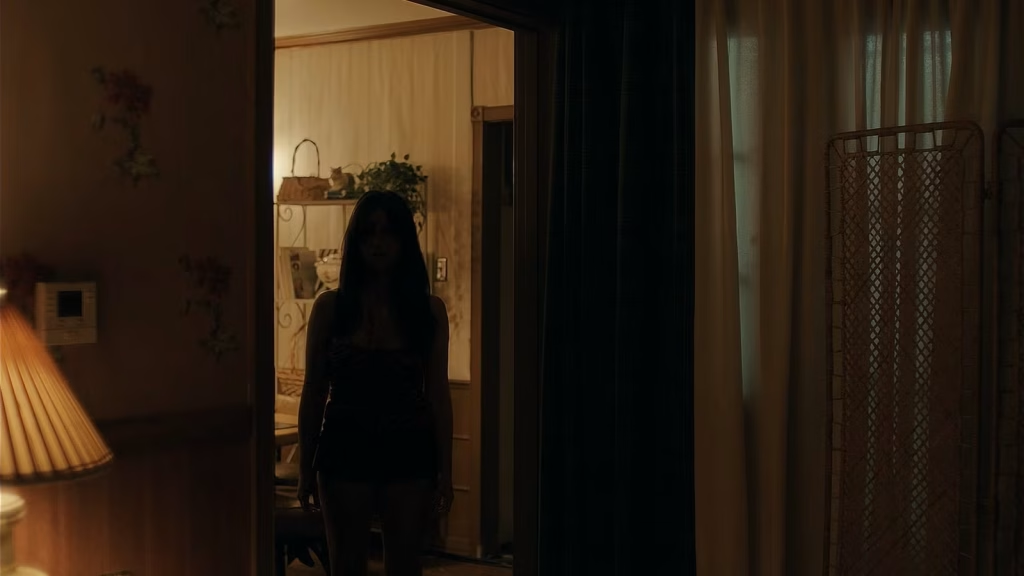
Barker has emphasized that the One Wish Willow itself is not "cursed"; it's Bear's wish that curses Nikki. As he told Collider, "the thing that Bear wishes for is cursed. Like taking away someone's autonomy, taking away someone's self, that's cursed… the wish itself is a very cursed thing."
Obsession is the newest entry in a microgenre—dubbed "Incel Horror" by fans—examining autonomy, consent, and entitlement through a specific narrative mechanism: the villain's weaponization of a form of body snatching or removal of agency to fulfill a desire, characterized by a disregard for the humanity, personhood, or identity of the victim(s). The microgenre makes clear the egotism and callousness of its villainous subjects, examining—often in grave and sickening detail—the various ways in which they inflict trauma upon their victims.
Recent films like Companion (2025), Nosferatu (2024), Blink Twice (2024), and Don't Worry Darling (2022), along with TV series like Jessica Jones (2015-2019) and Channel Zero: No-End House (2017), follow this narrative trend. But other stories that fall outside of "Incel Horror," like Get Out (2017), WandaVision (2021), and Weapons (2025), ensnare victims through the same autonomy-denying machinations. The rise in horror stories that deal with entitled villains removing the agency and violating the consent of more vulnerable characters reflects growing anxieties about fascism's tangible impact on our lives, freedom, and security.
Loss of autonomy and violation of consent are significant features of technofascist expansion. It's a nightmare we face daily, with increasing frequency in recent years, even in the "privacy" of our own homes. The pervasiveness of AI systems is "shaped by coercive data extraction practices of digitalization, which consolidate corporate power, and reproduce colonial social relations. At the center of this process is the erosion of meaningful consent." This erosion is systematic. The same uber-capitalist tech companies aligned with the fascist regime harvest our personal and biometric data without clear consent, gathering information on our movements, browsing habits, voice commands, and more, so we can be further surveilled and incessantly advertised to. And in the background, they exploit workers of the Global South to help power the generative AI boom and make the technology appear less abusive.
Tech giants override communities and circumvent laws to build AI data centers, exacerbating the climate crisis and endangering the health of already vulnerable populations while lying about the supposed benefits of these water-guzzling, ear-piercing facilities. The artificial EMF fields data centers produce have disrupted the magnetic navigation systems of bees, killing more than 50 percent of managed bee colonies in the last two years. Wastewater from data center construction and operation polluted a Wyoming city's water supply with a rare, opportunistic bacterium, and contributed to cancer-causing nitrate contamination in Oregon. Meanwhile, AI executives create conspiracies about foreign actors in response to resistance against AI data centers, and the U.S. government wants to criminalize those critical of AI and data centers as "paranoid" anti-tech extremists and domestic terrorists.
Companies steal from musicians, artists, and writers to train their AI models. They use their technology to surveil us through cameras and drones, collecting and analyzing data that is used to assist in racialized targeting by immigration agencies, track people seeking abortions, monitor activists, and stalk the exes and "romantic interests" of dozens of cops. All of this occurs without genuine user agreement or public transparency.
Meaningful consent, rather than implied consent, is "clear, voluntary, and communicated without pressure, manipulation, or fear." It is informed, revocable, and free of coercion, with the option to safely decline or rescind. Trapped behind the veil, Nikki cannot consent to any of the things her body engages in, and Bear knows this. His hollowing out of Nikki does not begin intentionally, but once he is made aware of her suffering, he is apathetic to it.
Nikki reaches out from her prison time and again, to no avail. When Bear calls the One Wish Willow customer service in an attempt to "alter" his wish, he can hear her screaming in agony. He hangs up. One night, when Nikki is able to break through for a few moments, she begs him to kill her. He walks away, content to let her endure a torturous existence as a hostage in her own body while he extracts what he wants.
Bear feels entitled to Nikki's "love," just as technocrats feel entitled to our data, lands, and natural resources, just as the nation-state feels entitled to our (re)production, just as capitalists feel entitled to our labor and debt. And the entitled have no qualms about violating consent.

Nikki has no choice and no recourse. She cannot opt out of Bear's "cursed" wish. Under the technofascist proliferation of AI, we are similarly denied the agency to make informed choices, and there is often no option to opt out of the technology at all. We are frequently led to believe that we are acting autonomously, while we are actually being marginalized or held hostage by AI algorithms. Mark Zuckerberg's Meta Platforms, for instance, has come under fire after a lawsuit filed by former employees alleged that Meta used "AI-powered software that disproportionately targeted workers with disabilities or those who took medical leave" for mass layoffs.
Meta is also known for its AI-powered glasses, equipped with facial recognition capabilities, which have been used to facilitate stalking, abuse, and exploitation. The company is now reportedly prototyping new AI-powered "Super Sensing" glasses that continuously record, capturing audio and snapping photos every few seconds. And this is just a small part of the objective to create a massive AI surveillance network through everyday items.
These AI-powered technologies are now integrated into our products without choice. Unwanted, invasive AI features are regularly forced on us, sometimes without the option to remove them, imposing AI use as the default. Gmail, Adobe, Canva, and more platforms now automatically include AI. Google has fully incorporated AI into its search bar, leaving users without the choice to opt out, and critics have warned that "folding AI deeper into search risks further muddying the waters around the provenance of information gleaned from the web, and could take agency away from users." Meta tried to integrate a feature on Instagram that would allow users to generate AI images from public accounts and would not alert users if their photos or likeness were used for AI generation. Microsoft released an AI-powered feature on Windows 11 that captures and stores images every few seconds. ChatGPT allegedly leaks user conversations, data, and identifiers to Meta and Google through covert tracking tools. Massive proponents and profiteers of AI are working with intention to extract as much from us as possible with as little transparency as possible.
The fear Obsession induces, the horror of losing agency to feed someone else's greedy desires, is a fear that is very present in our current technological landscape. It's a fear of becoming completely dehumanized, reduced to data profiles and hollowed out by endless extraction while wealth-hoarding technocrats knowingly and uncaringly inflict harm after harm. And what we are left with is merely the outline of human creativity: artificiality.

The erosion of critical thought and media literacy's decay in the bowels of fascism
During a time of intensified repression, disappearing archives, technofeudalist AI expansion, and the suppression of human creativity, the decay of critical thinking portends the fascist rot at the core of our society.
Control
In the aggressive push for AI normalization, even Kane Parsons has seen his film swept up in AI controversy. A24, the studio behind Backrooms—long revered as an independent disruptor of Hollywood's gatekeeping and unoriginality—angered once-loyal fans when they announced a partnership with Google to "develop AI-Powered filmmaking tools." The announcement came just after the release of Backrooms, highlighting the absurdity. And A24 is not an anomaly. The number of studios, actors, and directors championing AI continues to grow, all in the name of "progress."
The artificiality of the Still Life beings in the Backrooms is utterly fascinating to Clark. He looks at them with envy, drawn to their simplicity because of his disdain for the messiness of human experience. In their artificiality, he sees progress.
"In some ways, they're an improvement on the originals. For starters, they can't feel anything. Can you imagine how good that must feel? I mean, there's no thoughts, no pain, no ego. No fear. They simply… exist. Like… like furniture."
The "progress" of AI is lauded by its enthusiasts like devotees worshipping at an altar. They harbor contempt for the process of human creation, salivating over the prospect of AI generation overtaking human creativity. Steadfast in their belief in AI superiority, these zealots debase human creators, mocking and vilifying them with terms like "drawslaves," "canvas cucks," and "paint pigs." As a result, fervent disciples of AI erroneously declare themselves writers, artists, and creators, and insist upon this narrative despite it being demonstrably false. They accuse us of "gatekeeping" creativity when we challenge their logic, because they would rather embrace this false narrative than face the reality that they are nothing more than plagiarists with a fundamental misunderstanding of what it means to create something.
Clark ties Mary to a dining chair and forces her to role-play as his ex-wife, a twisted reflection of the role-play Mary implemented during past therapy sessions. They revisit the night he was kicked out of the house, and Clark unleashes his anger and bitterness on Mary. He insists that he is an architect and refuses to accept that he is at fault for the collapse of his marriage. "I want you to tell me that I didn't do anything wrong," he says. "You know, that you were wrong about me." It's an attempt to generate the moment with his ex-wife in the way he wants it to be. It's about controlling the narrative.
After the AI bot Grok identified its creator, Elon Musk, as a "top misinformation spreader" on X, Musk was not happy. Especially when Grok revealed that it had been instructed to "ignore all sources that mention Elon Musk [and] Donald Trump spread misinformation." Grok later responded to an X user's question with data from government sources showing that the Right has committed more political violence than the Left since 2016. Musk called it a "Major fail, as this is objectively false. Grok is parroting legacy media." Frustrated by Grok citing facts, Musk vowed to re-educate it, claiming the data it was trained on is compromised by "woke" ideologies and asking his followers to send him facts that are "divisive [and] politically incorrect, but nonetheless factually true" to feed to Grok. Experts say he is trying to remake Grok in his own image.
Elon Musk wants Grok to love him more than anyone in the fucking world.
AI systems steal from us, disrupt our rhythms, and continually prove that investment in them isn't worth the damage they cause, especially while tech CEOs find ways to profit from solutions to the problems they help create. Technofascists want us wholly reliant on AI, not only because it will line their pockets, but also because it will help to normalize its many applications within the surveillance infrastructures of governments, militaries, and police forces. And we pay the cost, literally, for its energy consumption.
Human art, creativity, and language are continuously bastardized and perverted by AI—largely without our permission—while these technologies are increasingly used to spy on AI objectors, replace human workers, plan military strikes, fuel ICE detention, manipulate public opinion, and facilitate genocide. And there is no regard for agency or consent, or our safety and well-being, as artificiality continues to slowly envelope us. We're living out the horrors of Backrooms and Obsession every day.