

"The dumbing down of America is most evident in the slow decay of substantive content in the enormously influential media… lowest common denominator programming, credulous presentations on pseudoscience and superstition, but especially a kind of celebration of ignorance."
—Carl Sagan, The Demon-Haunted World: Science as a Candle in the Dark, 1995
For months, I've seen reviews about the awful emptiness of Justin Tipping's sophomore film, Him (2025)—a sports-themed psychological horror, co-written alongside Skip Bronkie and Zach Akers, following the fateful meeting of rising football star Cameron Cade (Tyriq Withers) and industry icon Isaiah White (Marlon Wayans). The cultural consensus was/is that Him is "bad," and there's nothing of significance or interest to be found within its runtime. Not one to let reviews deter me from engaging in art that piques my interest, I watched it anyway, and I'm glad I did. What I found was a Faustian exploration of masculinity, religious fanaticism, racial capitalism, football worship, and disposability. Pleasantly surprised, I typed out a quick, critical thread on the subject.
Private responses to my analysis of Him were, in not-so-small parts, attempts to correct me: Accusations that I was "over-intellectualizing" my reading of the film. Demands that there was actually "nothing" beneath its slick imagery and gradual build. That I should stop trying to apply meaning where they had found none. That the film is just "bad" and anyone who appraises it as anything else is inherently wrong.

Him certainly meanders, at times like an ephemeral stream of consciousness. It's distorted and deranged, dysphoric and disorienting. And—as it is a psychological horror film told via the psyche of an athlete with increasing brain damage—I'm not put off by the increasing elusiveness of the narrative. Nor am I bewildered at not knowing for sure whether the ending is real or an apocryphal nightmare created by a swollen, concussed brain collapsing further into disorder.
I enjoyed my experience with Him despite its pitfalls because, regardless of how it handles its narrative elements, it still offers an intentional examination of football culture, and I find the attempts to negate that to be egregious and unfair. And concerning. Art, even when it isn't at its best, can still achieve thematic resonance. I concur with Corey M. Floyd's verdict on the film: "As horror, it's uneven. As a social critique, it's unforgettable." But this is not an essay about Him.
the death rattle
This is far from the first time I've offered my thoughts on horror and been told I'm "overthinking" it or had my analysis immediately disregarded with variations of "it's not that deep" or "just shut up and watch the movie." It's been happening for years. But it's happening more and more often as of late, and with more and more hostility. And it's indicative of something quite grave.
Let me be exceedingly clear: I'm not offended that others didn't enjoy this weird, nebulous bit of horror as much as I did, because art is subjective and each experience with art is personal. What I find interesting, others may find boring; what I find dull, others may be riveted by. What brings me pause is the vast insistence that Him is about "nothing" when myself and others are able to derive so much meaning from it. What brings me pause is the increasing ease with which people accost me—a culture and media critic—for thinking critically about art and even aggressively discourage me from doing so, especially when my analysis goes against the consensus. People are near-constantly diagnosing me as incapable of "just enjoying things," failing to realize, or refusing to accept, that critical analysis is an enjoyable part of my engagement with art.
Nearly a decade ago, the masses bent over backwards to find every bit of symbolism and messaging in Jordan Peele's Get Out (2017) and Ryan Coogler's Black Panther (2018). In recent years, I've witnessed these same filmmakers, who have only grown in their craft, have their work undermined and underappreciated to a degree beyond the unimaginative racist tantrums they inevitably bring. From complaints that the vampires were "random" additions to Coogler's Sinners (2025)—a film about the cultural vampirism of appropriators and the socioeconomic vampirism of the Jim Crow South—to audiences decrying the inclusion of Gordy in Peele's Nope (2022) as unnecessary—even though what happens to Jupe on the set of Gordy's Home! is key to understanding the narrative and solidifying its themes—the growing inability to grasp certain story elements and their thematic significance is stark. And bleak. To say the least.


There has been a noticeable shift in these conversations as fascism has gained a stronger foothold in recent years, particularly post-COVID and amid Trump 2.0, from general openness and curiosity to condescension and narrow-mindedness, almost as a matter-of-course. Alongside the disdain for media criticism—as in the serious consideration and examination of art—there is also a growing intolerance for stories and storytellers trusting the audience to think critically, make interventions, and glean significance from the art gifted to us.
Critical thinking is dying before our eyes.
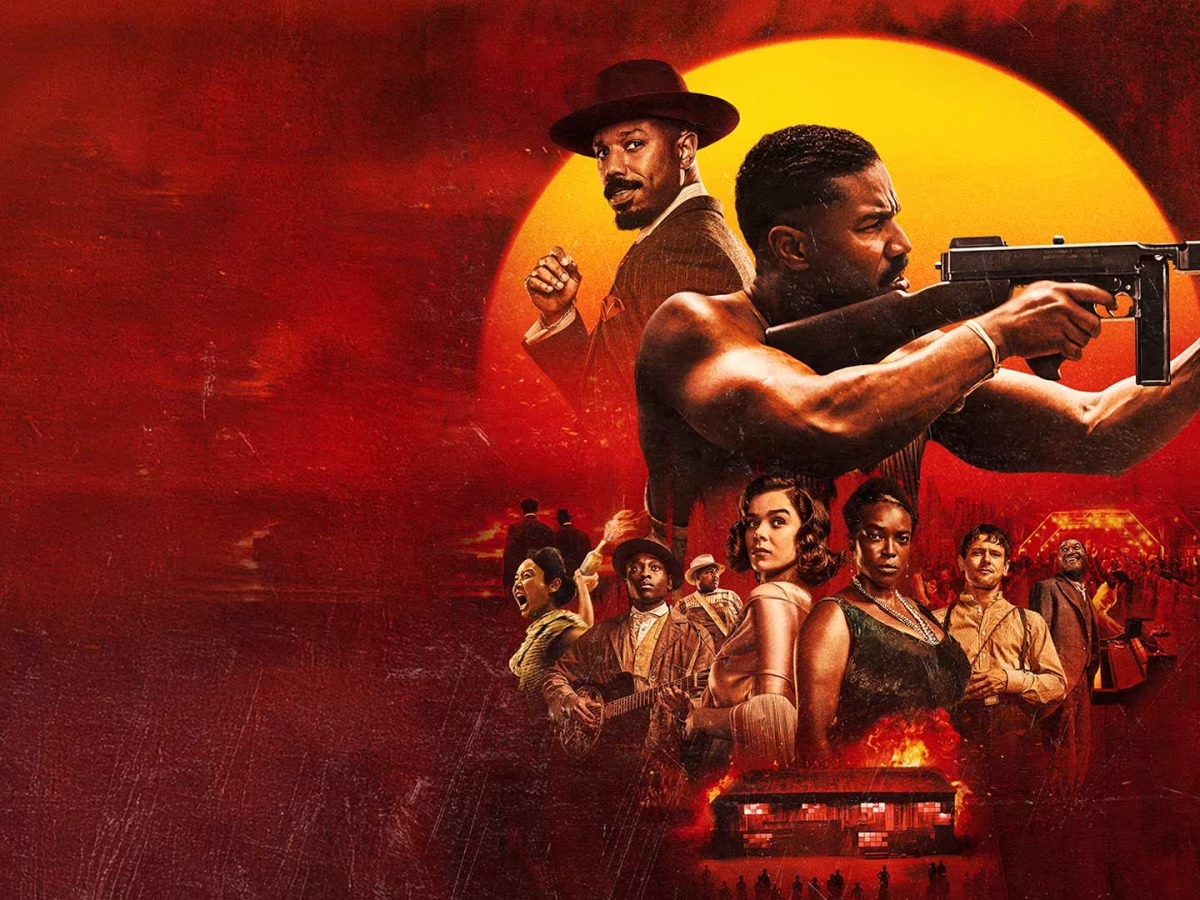
'Sinners' and the Legacy of Southern Vampirism
I see no distinction between a vampire clan and klansmen, between vampires and white supremacists, aside from the fact that the latter invade and destroy our spaces without invitation.
the algorithm as gospel
Perhaps more than ever, social media operates on groupthink and echo chambers, thanks in large part to the predictability of the engagement-maximizing and emotion-amplifying algorithm. At the same time—and, arguably, as a result—modern audiences operate more and more on literalism. In "The New Literalism Plaguing Today's Biggest Movies," Harvard professor Namwali Serpell names literalism as something akin to "when we say something is on the nose or heavy-handed, that it hammers away at us or beats a dead horse." Serpell writes:
"[To] re-state the screamingly obvious does a kind of violence to art… The point is not to be lifelike or fact-based but familiar and formulaic—in a word, predictable. Artists and audiences sometimes defend this legibility as democratic, a way to reach everyone. It is, in fact, condescending. Forget the degradation of art into content. Content has been demoted to concept. And concept has become a banner ad."
Literalism is the bedrock of what I call "second-screenwriting." In the early 2020s, Netflix and other streamers blazed ahead with a strategy centering "distracted" viewers, requiring media makers to create with the understanding that audiences use second screens while watching. Network executives ordered a swath of these second-screen movies and shows, resulting in an onslaught of overly-simplistic storytelling, stilted dialogue, characters announcing what they're doing or flat out stating their emotions, and repetitive, often redundant exposition. One media maker was told by Netflix, "You need to both show and tell, you need to say much more than you would normally say… You need your audience to understand what's going on, even if they're not looking at the screen." Another lamented the unthinking devotion to the algorithm the studio practices, explaining that "Whenever you talk to the algorithm people and the data people at Netflix, it feels like a cult. They talk about the algorithm like it's a god."
Stranger Things is the perfect microcosm of this phenomenon. The difference in the show's first season airing in 2016 and its final season airing at the tail-end of 2025 is drastic and abysmal.
"What once masterfully drew on '80s aesthetics with exciting stakes and authenticity stumbled through its final chapters with clunky dialogue, rushed character arcs and narrative pacing so inconsistent that you'd think different writers had handled each episode without consulting one another.
The writing was the biggest failure of the season. Characters explained their feelings or actions instead of showing them. The kids, now adults, delivered speeches filled with quips that sounded artificial intelligence-generated rather than thoughtfully written."
—Charlie Cruz, The Rice Thresher
Literalism killed Stranger Things. The show might be a blatant example, but it is certainly not anomalous. Other popular horror media also suffer from hand-holding exposition dumps and blatant "show and tell" moments. There are low-hanging examples from the Blumhouse-dominated horror content mill, like Imaginary (2024), Night Swim (2024), and Tarot (2024). But we also see it in critically-acclaimed films like Longlegs (2024) and Barbarian (2022) and in lesser-known entries like They Will Kill You (2026). This rise of second-screenwriting and dogmatic subservience to the algorithm—an absolute blight on storytelling—cannot be divorced from the increasing contempt for media criticism, and neither of these can be divorced from the simultaneous rise of anti-intellectualism.
"the blessings of illiteracy"
In 1963, historian Richard Hofstadter defined anti-intellectualism as "a recurring suspicion toward intellectual life in democratic societies." Intellectual life being the pursuit of and respect for "knowledge, critical thinking, and evidence based reasoning," as explained by writer Angelina DeSalvo in "The War on Reason: How Anti-Intellectualism Threatens Our Future." In this essay, DeSalvo notes that this phenomenon has historically "surfaced in moments of social unrest, economic anxiety, and political upheaval."
Moreover, what makes modern anti-intellectualism distinct in the digital age is "the amplification effect of digital platforms and the erosion of traditional gatekeepers of knowledge, such as academia, journalism, and public institutions." One major consequence of this phase of anti-intellectualism is that less than half of U.S. Americans now believe that climate change is caused by human activity, nearly 15 percent don't believe in climate change at all, and fewer people see climate change as a serious matter. There has been a gradual increase in disregard for what climate scientists and other experts have long warned us against, even as climate catastrophe worsens and environmental devastation is felt across multiple regions. Meanwhile, Trump's climate policy rollbacks jeopardize opportunities for global climate progress. Anti-intellectualism puts us and future generations in even more peril.
Anti-intellectualism unequivocally contributes to media illiteracy, which is characterized by passive rather than active media reception and an inability to "critically engage with and understand the media we consume." A national study by Media Literacy Now found that only 38 percent of adult participants learned how to analyze media messaging during their formal education.
"It's hard to say which came first: our so-called media illiteracy or the dumbing down of the media. Complaints about our inability to read, interpret, or discern irony, subtlety, and nuance are as old as art. What feels new is the expectation, on the part of both makers and audiences, that there is such a thing as knowing definitively what a work of art means or stands for, aesthetically and politically. This strikes me as a blatant redefinition of art itself… Rather than aiming for the unique, which might pierce our haze of distraction, art has succumbed to marketable generalities."
—Namwali Serpell, The New Yorker
Media illiteracy, too, is on the rise in the era of AI and disinformation, and it has, in fact, helped lead to a rise in misinformation. It not only affects the ability to comprehend fictional narratives but also the ability to discern propaganda, pseudoscience, and conspiratorial fearmongering from news and government sources, especially in an era where fascist-aligned billionaires are vying for total control of the news and entertainment media.
Authoritarian governments thrive in these conditions. Anti-intellectualism was a tactic used in Nazi Germany to amass power and propagate the regime's fascist ideologies. Hitler himself once declared, "Universal education is the most corroding and disintegrating poison that liberalism has ever invented… We must therefore be consistent and allow the great mass of the lowest order the blessings of illiteracy." During Trump's first presidential run in 2016, he proclaimed his "love [for] the poorly educated," openly bragging about how popular he was among non-college-educated voters.
A less educated, less actively-engaged, less media literate public is a less liberated public—more docile, more easily distracted, more easily controlled and exploited under fascism.
the mediation deficit
Beyond literalism, an uncritical audience also demands immediacy. Anna Kornbluh's Immediacy, or, The Style of Too Late Capitalism offers an interrogation of the lack of mediation—the "slowness or distance [that] is necessary to arrive at critical reflection, decent analysis, meaningful theory, or effective political action"—within a capitalistic culture that demands constant labor and disconnection. The absence of collective mediation on literature, film, television, music, politics, advertisements, and more also leads to an absence of collective organizing, mobilization, and resistance against the very system that seeks to relegate us to nothing more than cogs in the capitalist machine. Immediacy thrives in "a society or a culture which seems to move too fast, which lacks the space for mediation, deliberation, and reflection."
We see this lack of mediation not only in the realm of cinematic art but also in the literary arts. Thanks to the government-manufactured literacy crisis, both adult and childhood literacy rates are in free fall. College students can't read books or comprehend the complex ideas in them. There is widespread disdain for literary fiction, a more contemplative style of storytelling that aims, not to tell a story with "a gripping, nail-biting plot," but instead to "convey powerful messages about human life and the society we live in." Performative reading and overconsumption continue to pervade bookish spaces. BookTokers boldly proclaim that books have "too many words" on the pages, that they "only read dialogue," that they skip over prologues and disregard epilogues. There is a burgeoning puritanical hatred of criticism among certain bookish communities where the refrain "When did BookTok become political?" can sometimes be heard, especially when conservative ideologies in literature are critiqued. Meanwhile, popular influencers in the manosphere denigrate the practice of book-reading because, allegedly, their brains are "far too advanced" for books. The cultural relationship to reading is changing.
Beyond this, the infiltration of AI into the literary world epitomizes immediacy more than perhaps any other modern invention. Opportunists use AI to instantly spit out poorly assembled jumbles of words and falsely declare themselves "writers." At the same time, some claim to have read 100 books in a week when they've actually read 100 five-minute AI summaries, completely oblivious (or apathetic) to the plot of Fahrenheit 451—a dystopian novel in which books are condensed into brief summaries before being banned entirely and ultimately systematically burned by a fascist state.
And we, tragically, are getting closer and closer to that reality.
the AI pestilence
AI has become one of the biggest barriers to collective mediation, exemplifying the allure and dangers of embracing immediacy. As Naomi S. Baron writes:
"It's too soon to know what effects AI might have on our long-term ability to think for ourselves… But if we lose practice in reading and analyzing and formulating our own interpretations, those skills are at risk of weakening.
Cognitive skills aren't the only thing at stake when we rely too heavily on AI to do our reading work for us. We also miss out on so much of what makes reading enjoyable—encountering a moving piece of dialogue, relishing a turn of phrase, connecting with a character.
AI's lure of efficiency is tantalizing. But it risks undermining the benefits of literacy."
Serpell calls redundancy the "dullard cousin of the repetition family." The redundancy of literalism goes hand in hand with the immediacy of AI. Large language models are merely plagiarism machines, aggregating and pilfering the work of others and distilling it into soulless repackaging. Using AI is not creation; it's the repetition and abbreviation of what has already been created by others. Redundancy and immediacy, nothing more. Still, there is a growing cultural expectation to outsource critical thinking skills to AI chatbots and assistants, so much so that it has become an absurd trend for commencement speakers to pressure college graduates to accept AI as inevitable (before getting promptly and deservedly booed).
AI and fascism are indivisible, and "fascists and other demagogues have seized on AI as a tool of social destruction and terror." Not only are companies like Palantir and Corsight using AI to enact genocide and track people through biometric data and predictive algorithms, but police are now monitoring social media users who criticize AI data centers and their devastating environmental impact as potential "domestic violent extremists."
Technofascist Sam Altman, the CEO of OpenAI, told us exactly what the endgame is—beyond a panoptic police state and omnipresent AI surveillance, that is. Altman informed attendees at the BlackRock U.S. Infrastructure Summit that he sees "a future where intelligence is a utility, like electricity or water, and people buy it from us on a meter." AI decreases prosocial and altruist intentions, promotes dependence on AI tools, and weakens critical thinking skills, and wealth-hoarding misanthropes like Altman are counting on it because they have every greedy intention of selling a bastardized version of "intelligence" back to us while destroying the planet in the process. And many will be too AI-dependent to notice.
This "too late" stage of capitalism is becoming frustratingly, painfully dull for anyone who craves something beyond the overwhelming immediacy and literalism amplified by the algorithm-driven, AI-contaminated streaming age. As the more complicated and intricate stories begin to disappear in favor of "second-screenwriting" and nostalgia bait, the culture industry becomes overly saturated with uninspired and uninspiring "content"; diversions meant to lull us into docility as we labor under capitalism. And when capitalism exhausts us, and we go in search of escape and reprieve, what we find is less and less art, and more and more "content." And very little originality. As Serpell observes, AI's "derivative ethos seems to have permeated all forms of media. Everything must be easy to follow and to understand, simple enough to recognize and categorize."
And so, often, when media comes along that doesn't offer the level of literalism and immediacy many viewers have grown accustomed to in recent years and have now even come to expect and rely on to interpret media, a notable amount of responses are not rooted in curiosity about what that media has to say, but in disdain for its audacity to say it with nuance and symbolism rather literalism and immediacy. "Everything must be easy to follow and to understand, simple enough to recognize and categorize."

Recipes
The scent of magnolia and pine had been eaten away by the smell of rot, barren earth, and sulfurous smog.
(kill) the fascist in your head
In this climate, an overarching disdain for media criticism and critical thought means that going against the dominant opinion about particular media can make critics a target for virulent mobs—whether that dominant opinion is negative or positive. When a well-reviewed and widely-loved film like Weapons (2025) receives fair criticism for its overly-expository nature and an ending that fails to achieve "thematic and narrative cohesion" (among other things), feral defenders descend to vilify, censure, and condescend. Anyone who doesn't herald it as "one of the best films of the year" is a heretic.
In his self-conducted exit interview and farewell column as a New York Times film critic, A.O. Scott addresses this state of modern fandom, writing,
"The behavior of these social media hordes represents an anti-democratic, anti-intellectual mind-set that is harmful to the cause of art and antithetical to the spirit of movies. Fan culture is rooted in conformity, obedience, group identity and mob behavior, and its rise mirrors and models the spread of intolerant, authoritarian, aggressive tendencies in our politics and our communal life."
The impulse to attack or silence dissenting opinions is a fascistic impulse, whether those opinions be about a polarizing piece of media, or about the politics that impact our lives. It promotes homogeneity, echo chambers, and groupthink in the virtual world as well as the material world. It is the antithesis of the collective mediation we need, both to work collectively in political action and to form individual viewpoints and taste in media.
The death of critical thinking is also the death of authenticity.
Engaging critically with Him is exactly what Justin Tipping wants us to do. He said so himself in Variety, sharing his excitement about using the fictional story of Cameron Cade and Isaiah White "to get people thinking critically and talking about one of America's biggest pastimes." Football.
"If your body's your only capital, and you get injured or age out, you are just a warm body that is moved through spaces and is disposable. If that's the horrific, underlying thing, I think there's a lot to explore there… But it's tackling all at once the business side of sports, and the dark side of the business."
To think critically about art is to think critically with the artist. To eschew immediacy, to digest slowly and completely. It's our privilege and our imperative to critically engage with media, whether it be a football-themed horror film, a smutty romantasy epic, or billionaire-sponsored propaganda. The algorithm-manipulated, fandom-dominated cult of immediacy is a harrowing manifestation of the ways this "too late" stage of capitalism helps to foster the insidious brand of fascism we now struggle against. It relies as much on the fascist repression and policing of the collective by the collective, as it relies on the collective being policed, surveilled, and exploited by the fascist state.
During a time of intensified repression, disappearing archives, technofeudalist AI expansion, and the suppression of human creativity, the decay of critical thinking portends the fascist rot at the core of our society. Fascism is a coercive and corrosive doctrine, and independent, critical thought will always be a threat to authoritarian regimes that exalt fascist cruelties.
Media criticism is not a frivolity. Media literacy is not trivial. Thinking critically about media is not over-intellectualization.
In this "too late" stage of capitalism, it's not too late to undertake the task of forming a more united front in this fight. It is vital that we fully commit and invest our time, energy, and care into reclaiming critical thought and media literacy with intention and deep(end) conviction in the face of (c)overt fascism. With press freedom at an all-time low and the government criminalizing dissident perspectives as "terrorist threats," it's our collective duty to wage a cultural war that reanimates media literacy as a tool to stand against fascist weapons of censorship and the erosion of critical thought. This work—as we, the repressed and silenced know all too well—demands we give it our all. And take it seriously.
In the words of Isaiah White, "This ain't a fucking game."