

Jahnah Camille is a headliner at this year's Mainline Music Fest in Atlanta. For more information and tickets, go here.
If you're a music lover like me—and the people for whom this column is intended—you might engage in what's now called "active listening." If you're an active listener, you likely have a particular penchant for things other people, commonly referred to as "passive listeners," don't.
That little slide on the guitarist's fretboard. That one vocal cadence in verse three that's different from verse one. That extra punch on the mix of that snare drum in that chorus. Those little details that distinguish different artists from each other and different parts of artists within themselves. Those specific places where the production meets the song's original vision. Whether or not that vision is fully realized in all these elements depends on who's behind it making these choices.
That's active listening. Being a music lover (or simply, a "music person"), however, encompasses something else entirely … another brand of fixation possessed by a certain subpopulation of people that are impossible to miss within 15 minutes of meeting us. We share tendencies with addicts. We are those caricatures of people in High Fidelity in real life. We are, admittedly, kind of annoying as a people, in the way comedy writers can be. For comedy writers, everything is a bit; for music people, everything is a song … and a song can be everything.
For music people, when a sound catches our ear, we're locked in, and nothing else matters. Whether the little details and embellishments we notice only last for a millisecond or take up a section of a song, they invariably take up a lot of space in our lives. Fixated on sounds that move us, we find ourselves combing through liner notes or oddly specific sub-Reddit threads hungry for more information. We force particular songs or albums into our conversations, hoping others have heard it and might just be willing to join us in our reverie. It is this obsession that leads many music people towards performance and practices of music appreciation. Some of us start magazines and pen music columns like this one, while others start podcasts, record labels, or curate communal listening spaces.
Jahnah (pronounced "Hannah") Camille became a music person as a child when her father started taking guitar lessons. The 22-year-old Birmingham-based songwriter, guitarist, and vocalist's first musical memory may have come by way of someone else learning, but it wasn't long before she too became a student. Camille began playing the instrument at age four and by the time she turned 10, had added songwriter to her repertoire of musical practice.
"My dad took guitar lessons when I was kid," remembered Camille in an interview for Scalawag. "He had a teacher come to the house, so that was my first exposure. Then I immediately took up the instrument myself. After a few years of playing, I started writing religiously."
Camille has cut her teeth and honed her skills at a level that surpasses many of her peers. The multitalented artist is counted among the ranks with artists like Clairo, TOPS, Soccer Mommy, Blondshell, and Luna Li—all for whom she has served as an opening act following the release of her debut EP i tried to freeze light, but only remember a girl (Winspear, 2024).
I saw Camille perform for the first time at the Masquerade in Atlanta, a beloved performance venue that was once a historic three-story building located on North Avenue with a stage on each floor: Heaven, Hell, and Purgatory. Old Fourth Ward gentrification pressures and mishandled local politics a la the Atlanta Way forced the venue to move in 2016. Now located in Underground Atlanta, the venue maintains its three stages in three separate rooms. What was once an easily discoverable space for music has now become a maze, and truthfully, one I rarely embark on. Fortunately, I caught Camille there in January 2025.
It was an abortion rights benefit show hosted by Ground Control Touring featuring Camille along with Atlanta heavy-hitters like hardcore stalwarts Playytime, indie post-punk darlings Omni, Southern gothic songstress Zoe Bayani, indie rock outfit girlpuppy, and others. In the midst of heavy noise and flashing lights, Camille stood out. Sitting on a stool center stage, just her and her guitar, busting out these incredible songs that prompted me to halt all distractions, look up, and find out who she was. Her performance unlocked a new discovery portal, and I dove headfirst, not just into the world of Camille, but into the Birmingham music scene.


My music journalism career, thus far, mostly spans Atlanta artists. I began my writing career at Creative Loafing in the spring of 2017. By that holiday season, the paper laid off a majority of its staff. After massive layoffs and a drastic restructuring at the paper, I started Mainline, where we've almost exclusively covered Atlanta artists. (And, as a testament to the abundance of the Atlanta scene, we've stayed busy covering it.) Now, at Scalawag, a regional Southern paper, I get to expand my beat beyond my hometown.
Just a two-hour drive from Atlanta, I consider Birmingham our sister town, but I barely know anything about her. I know that the Saturn is a favorite venue among touring artists in the South and beyond. (I've been told their green room and artist hospitality is unmatched.) I also know that, like Atlanta, Birmingham's legacy of plantocracy rule and Civil Rights resistance has kept it at the forefront of fascist Southern politics and antifascist resistance. While I am still getting to know Birmingham more intimately, I do know that for every town with a repressive government, there is a music scene that resists it. And the more intense the repression, usually, the more bombastic that scene is.
In our interview, Camille described the Birmingham scene as having a strong "anti-corporate" and "insular" culture. Marked with a saturation towards heavier music, Camille said, the scene does carry a "political pulse," with intrinsic values she appreciates.
"There's a lot of benefit shows we'll have to benefit specific people in our community," added Camille, reflecting on what she values in the Birmingham scene, aside from standard criticisms. "A lot of mutual aid and a lot of benefit shows for the people in Gaza. I think that's amazing to keep at the core. It's a lot of people who will create no matter what, because it's not really a career thing for them. It's just like the only meaningful thing a lot of us feel we can do with our lives, and that's certainly how I feel."
Based on our interview, her music, and everything I have read about her, it's clear that Camille is in the business of her own personal growth as an artist, which is what seals her authenticity about her. While our industry continues to grapple between the worlds of capitalism and creativity—with increasing challenges coming from media consolidation, AI, genocidal CEOs, and ICE-recruiting streaming platforms—artists are fighting more than ever to preserve their own and our world's humanity.
"A lot of people make music no matter what, even if it is deeply inconvenient," said Camille, reflecting on the connection between music and liberation. "I think for a lot of people that means putting it over their work that makes them actual money. I do think that's liberating in a way to love something enough for it to be worth more than the actual currency in our lives."
Camille's rising star and continued growth is an example of what music people like myself deeply appreciate, especially right now. There's a great satisfaction in following someone's journey and witnessing an artist's craft organically blossom. Not trying to hack the system, not trying to go viral. Just trying to hack something within themselves to unleash a whole new world. The South, from my observation, is full of artists like this, full of a special type of earnestness and a build-it-yourself nature that I haven't seen as much in other regions. Camille told me she carries a unique respect and affinity for Southern artists, saying that the craft comes from a place of necessity rather than a place of luxury, separating our homegrown innovators from the bourgeois artist class.
"I love artists from the South," Camille reflected fondly during our interview. "I feel like the South has a really loud and clear rulebook, and if you're from the South, that means you're extra defiant. I really admire that. I think when you're from a major city, and everyone is an artist, it doesn't deviate that far from expectation. But if you're from the South, it's a very clear choice. And I really respect that in my peers. It's like we're choosing to have this path."
Jahnah Camille's Alt-Southern Soundscape

Camille's debut i tried to freeze light EP is reminiscent of fellow Southern artist and Atlanta native Faye Webster's blend of indie folk, dream-pop, and R&B, served up with a deadpan and understated vocal delivery. The EP was produced by John Michael Young, formerly of the aforementioned Atlanta-based project girlpuppy, with a special co-write cameo from Atlanta native Thomas Sinclair, who also once served in the girlpuppy arsenal. (Sinclair has since moved on to pursue projects like his own Elesa Sparkle, the collaborative and post-punk-inducing Safety Switch, and the indelible indie rock outfit major. All are most definitely worth listening to.)
i tried to freeze light is excellent in its own way and has all the markings of a classic indie folk-rock-meets-dream-pop record, including driving chord progressions, slides, and some elevated synths, lending listeners a bigger soundscape than traditional folk offerings. This is especially true in the EP's closer, "carnival sounds," which was co-written by Camille, Young, and Sinclair. Stripped down, though, much of Camille's signature comes from her lyrics, which examine the everyday heartaches, anxieties, and disappointments that typically mark the angsty transition from teen girl to young womanhood. All of it is extremely relatable, but how much of the rubber has really met the road when we're teenagers? i tried to freeze light's songs are rooted in themes that clearly show a young person exploring ways to mask and contort themselves to make certain relationships and people fit into their life. But Camille's follow-up EP My sunny oath!, is a more substantial and existential offering.

"Turning inward from past love songs, My sunny oath! (Winspear, June 2025) explores rejection as a form of self-protection," reads Camille's official press materials. "'sit with you (pain)' quietly ponders expiring friendships before a bombastic rock outro. 'I got really comfortable with the idea of cutting off absolutely anyone who needed to be cut off, and that caused a lot of pain,' said Jahnah. 'It's not about a romantic relationship at all. But, I knew if I didn't make it a habit of choosing myself now, I would keep choosing people in every part of my life who would take advantage of me.'"
While i tried to freeze light grapples with the interpersonal, My sunny oath! contends with something bigger. Made with Asheville-based engineer and producer Alex Farrar (Wednesday, MJ Lenderman, Indigo De Souza, Horse Jumper of Love) at Drop of Sun Studios in Asheville, the EP opens with "close to you," a song about a crush Camille has on someone she's never spoken to. Stanzas like "Close to heaven, close to you/I've been choking on my words/Hope I get close to you" are nostalgic of PJ Harvey, the legendary UK artist I refer to as the cousin of Patti Smith and Iggy Pop, who released her debut LP and masterpiece Dry when she was just 22 years old. Harvey, especially after her first record, has a tendency to conflate her experiences with interpersonal love and romance with a God-like force of nature that transcends our petty human tendencies.
Harvey, whose creative and musical process was the means by which she grew up much like Camille, seemingly resigned to the idea that it was the universe or what some call "God" that was worth singing about more than any human subject, especially men. She'd do this while exploring how that higher power comes at us often through our interpersonal relationships or people we haven't even met yet, such as in songs like "O Stella," "Send His Love to Me," or "Urn With Dead Flowers in a Drained Pool." Some people might call this pedestalization or romanticization. I call it romantic transcendentalism.
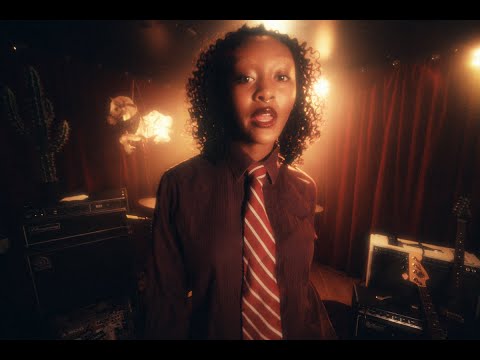
The EP's lead single, "what do you do?", is most certainly the pop hit of the record with a fun complementary music video wherein Camille spoofs Nathan for You, auditioning different people to be in her band in a sun-drenched, rundown bar. This playful motif, served up in the form of a bona fide pop single, combines arpeggiated riffs, sonic-powered guitars, and beatific drum patterns, invoking another major influence for Camille: Liz Phair. Camille cites Phair's work as inspiration for the EP, unabashedly stating "That album Whip-Smart … I was really, truly, deeply obsessed with that."
Like Phair, Camille's writing is a commentary on the mundane; it tends to the ways everyday life's small interactions give way to existential tension at the heart of our desires, such as that between wanting independence, but also an all-consuming lover; wanting to be a better person, but still willing to throw it down the drain for a whirlwind love affair.
Camille's work with Farrar is its best in standout tracks "rocket" and "sit with you (pain)," two songs that best exemplify Camille's growth as an artist alongside Farrar's phenomenal additions to the production.
"Examining the juxtaposition of repulsion and sex appeal, the lyrics [in "rocket"] zoom out to consider misogyny's 'great cost for life' among women worldwide," reads Camille's official press materials. Here, whoever was once on Camille's pedestal has been ripped right off: "I used to leave my hands open/And raise them above/Used to think that you were someone/Who could lift me up … I think I've seen/Enough of me at your feet." This moment marks the apex of Camille's resounding strength as a songwriter, leaving listeners yearning, with bated breath, for what's next.
If "close to you," the album's opener, sounds like sunlight shimmering through the trees, then "sit with you (pain)," a track at the heart of the record, feels like stepping outside on a Southern summer day. Here, Camille's craft explodes as sonic-powered guitars collide with her once-delicate lyrical renderings of heartache, transforming the break-up experience into something more powerful. While the earlier tracks float closer to heaven, "sit with you" marks a descent into emotional hell: "Got smaller then got grown with you/I can't choose you anymore … If six feet is as close as we get to hell/I'd take the pain out of this world." The track showcases Camille's true power: that she's not afraid to sit in discomfort and pain, and therefore, grow from it.

While Camille identifies as an artist dedicated to making music for art and liberation's sake, she is not shy about her career ambitions. With two critically acclaimed EPs now under her belt, she now has her sights set on becoming a producer.
"I really want to have a lot of freedom," said Camille when I asked her what drew her towards wanting to learn how to produce music, which is quite an undertaking. (I know this because I also caught the bug and have been slowly learning in the midst of the usual demands of life.) "I've always kept myself in the box of 'songwriter,' but when you're a multi-instrumentalist, and you can engineer and produce, you can make things sound exactly how you want them to sound. For a long time, I let other people's limiting beliefs get to me, and I started to think maybe I'm inherently not as capable of doing these things. I have really resented that recently, because I realized that it's a lie. And the boys aren't even doing it better, so why would I leave it to them?"
She's not wrong, and the world indeed does need more women, queer, trans, and nonbinary producers. Today, astonishingly, women and nonbinary people are vastly outnumbered by men in the profession, accounting for only two percent to six percent of credited producers in popular music. This means for every single woman or nonbinary producer in the industry, there are roughly 30 to 47 men.
At the risk of employing gender essentialism, imagine being the only woman or femme person in a room of 47 men. That is often what being a musician or a music professional who happens to not be a man feels like. (If a certain pain resonates with you here, please go heal yourself by watching the series adaptation of High Fidelity starring the amazing Zoe Kravitz and/or the Women Who Rock docu-series directed by native Chicagoan music and culture critic and former Pitchfork editor-in-chief Jessica Hopper.)
The film industry still gatekeeps the majority of the director and producer roles from women and nonbinary artists, thus producing popular media images tainted by the male gaze that reinforces and perpetuates patriarchy, and the same holds true for the music industry. Producing your own music is power and total control—something that often gets lost in translation when femme artists take their music to male producers. While Camille has had only positive in-studio experiences so far with her male collaborators, she understands that this is an exception and not the rule. In music, independence means empowerment; and the more empowered we all are, the better the music is. For now, her dedication to growing as a producer and songwriter is more in service of accelerating personal growth, rather than proving a political point.
Currently sitting in the space between her two released EPs and her forthcoming debut album, Camille says she is allowing herself to take more time to sharpen her skills, explore her songwriting more deeply, and give herself the space to grow.
"The next project is going to be a really long time from now, and that pains me to say," elaborated Camille. "I'm still in the process of demoing and teaching myself production. I really needed to take a long time to write really good songs, because I think debut albums in general [have] a lot of pressure on them. My favorite artists' debuts are a lot of the time my favorite. So I really need it to fuck, you know? I'll go a long time in between if that's necessary."