

I recently came across a viral video about a "Grim Reaper" who buried nine slave owners alive in Charleston, South Carolina. As a self-proclaimed gothic nerd, horror connoisseur, and lover of stories of Black resistance and vengeance, I did my research. To say I was eager to find out more about this Grim Reaper—and perhaps learn something new and interesting about the mythology behind the most well-known personification of Death—would be an understatement.
My research led me to another viral video about a man named Solomon Fairfax. In the 1850s, he spent four years exacting revenge on slaveholders, earning the nickname "Grim Reaper". Both videos have over one million views, and hundreds of thousands of likes, shares, comments, and saves. But, unfortunately, Solomon Fairfax doesn't exist.
His story didn't exist before September 2025 and seems to originate from a YouTube channel called Liturgy of Fear that almost exclusively posts AI-generated stories set during U.S. chattel slavery.
The channel boasts other videos that rely on the same revenge narrative formula as the story of Solomon Fairfax. Videos like, "Lazarus's Revenge: The North Carolina Slave Who Burned 9 Masters Alive," and "Big Jacob the Silent: The 7-Foot Slave Who Crushed 9 Masters' Windpipes Without A Word," and "They Called Him 'Devil's White'… The Albino Slave Who Skinned 9 Overseers Alive Georgia 1853." There's even another video that tells a story equivalent to the myth of Solomon Fairfax: "Solomon the Gravedigger: Buried 12 Plantation Owners Alive in Holes He Dug for Others."
The titles are clickbait. The thumbnail images are all derivatives of each other. The stories take advantage of the very real horrors real Black folks experienced on real plantations in order to spin falsehoods that traffick in the most vile imaginings of sexual and reproductive violence, torture, lynchings, and more.
Witnessing so many people comment on the story of Solomon Fairfax, accepting it as truth and disseminating it to so many others without further examination, is both jarring and disheartening. Not only does it illuminate some of the most significant media literacy issues of our time—a general inability or unwillingness to research and/or a disinterest in self-education—it also highlights the gaps in general knowledge about the real Black history we should all know more about.
This channel mines true stories of Black trauma and resistance to slop out Black trauma porn disguised as slave revenge narratives. Meanwhile, not enough people know about the real women who calculate resistance and revenge in Nikki M. Taylor's Brooding Over Bloody Revenge or that there were hundreds of slave insurrections beyond Nat Turner's rebellion, as Herbert Aptheker records in American Negro Slave Revolts.
It dreams up a plantation where "300 Slaves Vanished on Christmas Day," never to be seen again, leaving only broken chains in their wake. Meanwhile, not enough people know about the real events that historians call slave stampedes, in which "larger groups of Black freedom seekers [moved] together toward liberation, sometimes armed and ready to defend themselves."
It fabricates the story of an "Auction Where Women Bid for the Most Beautiful Male Slaves." Meanwhile, not enough people know of the real stories of slave purchase, ownership, and exploitation by white women detailed in They Were Her Property: White Women as Slave Owners in the American South by Stephanie Jones-Rogers.
It concocts stories of Black enslaved geniuses like the fictional "Daniel King… Whose Mind Predicted Deaths Before They Happened." Meanwhile, not enough people know about Thomas Fuller, a Black man whose grasp of mathematics was so advanced he became known as the "Virginia Calculator" in the 1700s. Or Eugene Hoskins, whose precise knowledge of calendar dates and train times astounded society in the early 1900s.
Even the videos covering real historical figures like Harriet Tubman invent information. One video claims to have uncovered what Tubman was doing during the years she "vanished from the historical record" and uses an AI-generated image of someone who doesn't resemble her in the least, even though there are several verified photographs of the abolitionist icon.

Sci-fi, fantasy, and fascism
Again and again, stories indistinguishable from sci-fi and fantasy narratives are used to justify fascist endeavors and uphold white supremacist understandings of race, history, indigeneity, colonization, and the world at large.
I wish I could say Liturgy of Fear is the only channel producing this hogwash. Regrettably, there are also such channels as Blood Mountain, Legacy of Fear, Legacy of Chains, and The Slave's Revenge—all presenting erroneous, AI-generated drivel as legitimate entries in the historical record, all pilfering and misrepresenting Black history for profit. The insidiousness of this phenomenon cannot be ignored.
We have a wealth of real stories of Black resistance. The true stories of Black genius and inspiration, in spite of forces working to diminish them, are bountiful. And there are damn sure plenty of true accounts chronicling Black trauma and death. Lord knows we don't need AI to vomit up any fraudulent ones.
It's important to be more vigilant than ever in the era of AI and as this administration escalates its attacks against Black history. Manufactured viral stories like that of Solomon Fairfax thrive among a population eager for stories of resistance against a fascist regime in a moment when the violent, imperialist apparatus continues to fortify itself against dissent and rebellion. The increasing prevalence and believability of AI slop, the censorship of Black history, the decline in media literacy, and the rise of anti-intellectualism have left us in a perfect storm of susceptibility to these types of frauds.
The responsibility of preserving Black history belongs to all of us now, and that archival work is becoming more important than ever. We didn't ask for it, and it's dystopian as all hell, but we have inherited a social librarianship. One that must contend with AI-generated stories that muddy the waters, create false beliefs, and will ultimately work to sow seeds of doubt about our real history in the future. The care and keeping of this history means being more accountable with the stories we engage with online, verifying before sharing, and calling attention when we see falsities circulating.
Bad actors will always take advantage of new technologies, and anti-Blackness will manifest in more new and grotesque ways as those technologies evolve. And in an anti-Black world, these bad actors will too often be driven by the desire to siphon as much as they can from Black folks. We know all too well, painfully well, that the vampires will always try to bleed us dry.
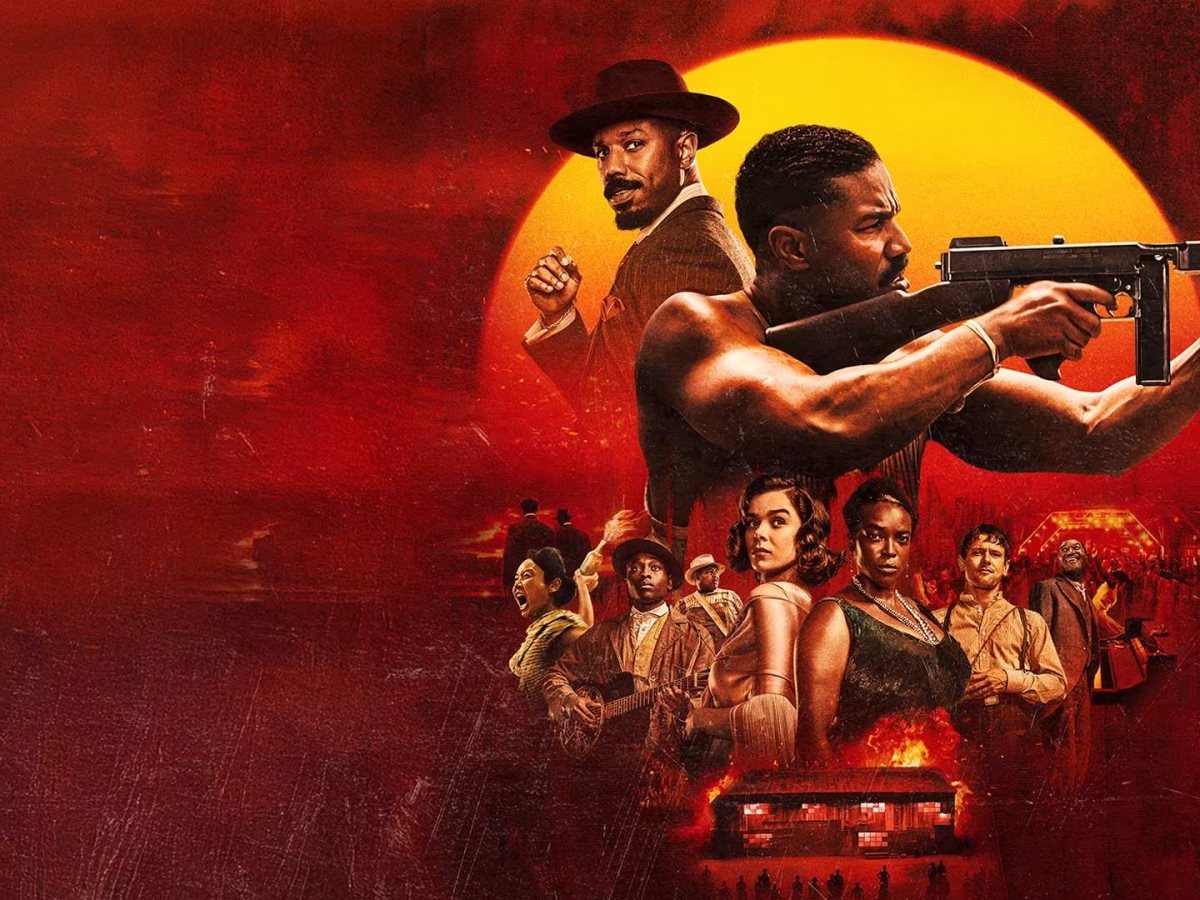
'Sinners' and the Legacy of Southern Vampirism
I see no distinction between a vampire clan and klansmen, between vampires and white supremacists, aside from the fact that the latter invade and destroy our spaces without invitation.