

How do we define "The South?" What is it about Black Culture, Americana, and anti-Imperial struggle, that even when obscured or not explicitly named, is deeply Southern? As a Southern publication, Scalawag is committed to defining and redefining the way "The South" is conceptualized in cultural discourses, as we, at the same time, uplift storytelling that centers the lived experience and perspectives of folks living in and native to the South.
This year, Scalawag contributors offer a robust selection of "Southern Cultures" pieces traversing topics from historical preservation and hidden histories, to art and literary criticism, and even dystopian short fiction. These selections from our Southern Black Histories, and Octavia's Parabellum series, the Cumulative Realities: Queer Poems the Liberated Future National Poetry Month special collection, guest edited by Aurielle Marie Lucier, Pop Justice newsletter, and Arts and Soul section are just as much about defining and redefining The South and Southerness, in Southern terms, as they are intended to ignite a radicalizing shift in the way we read Southern cultural representations and movements.

"The worn path in the woods that my siblings, my father, and I had tread in the early 80s was the remnants of a road that, at one time, was lined with wooden poles supporting the decapitated heads of alleged slave insurrectionists. These 'rebellious Negroes,' as the author refers to them, took a chance at freedom over a life of bondage.
But that wasn't the end of the story. It was just the beginning."

"1944 marked close to seven decades after the end of the Reconstruction Era, a period that never lived up to its promises of a better quality of life and opportunities for formerly enslaved Black people. The U.S. was also several years into fighting World War II. A war in which more than a million Black men and thousands of Black women would eventually serve. Steve's family were sharecroppers, a vocation that, even after the end of chattel slavery, still ensured their servitude to the landowner through a cycle of indebtedness."

"The current state of the Edmund Pettus Bridge, a structure that became a symbol of both brutal oppression and ultimate triumph, raises important questions about infrastructure equity. Safe, accessible transportation infrastructure isn't just about physical movement; it's about economic opportunity, community connection, access to nature, and social justice. While the Edmund Pettus Bridge has become a powerful symbol of the Civil Rights Movement, attracting annual pilgrimages from politicians and activists, Selma itself reveals a stark disconnect between symbolic recognition and substantive change. Despite its historical significance and regular visitors, the city continues to face economic challenges."

"My grandmother cared for my sisters and me through sweltering summers, and taught us early on that land is not only sacred but foundational to our long-term care.
The land always gave us more than we needed—this blessing of abundance was often celebrated when neighbors came over to share in the harvest."

"Despite the extraordinary achievements of the Workshop and its artists, the broader established Louisville art scene didn't care to engage or elevate the group. The city's galleries, dealers, and most collectors didn't want anything to do with Black artists at the time. What Workshop members were going to achieve, they were going to achieve outside the mainstream. Together."

"Ambrose Rhapsody Murray (b. 1996, Jacksonville, FL) calls on their Floridian and Carolinian roots through their artwork and practice. Depicting figures and historical images shrouded and layered in fabrics, their work pieces together history and myth with an intimate familiarity. Murray's work acts as a site of possibility, utilizing historical memory to think through the imaginative and mystical potential of the Black body. The artist's works shed light on the narratives and folklore that have become colloquial to Black history, especially Black Southern histories, such as the myth of the Flying Africans."

They tried to bury him: The hidden history of Abram Colby
"Like the other Black Radical representatives in the 1872 register, Abram Colby's redacted story floated among lengthy glowing accounts of his white legislative assembly peers. Colby's second biography, published in a county history book, described him as an ignorant drunk who insulted a lady and was thrown out of town, never to be seen again. These archival records are all that comprised the entire memory of Colby for generations, save for one other detail preserved by his congressional testimony: the Ku Klux Klan once beat him so severely that a doctor mistakenly declared him dead."

"If you search for Butler's words on pessimism, the main quote that comes up is her describingherself as 'a pessimist if I'm not careful.' This is the quote that everybody turns to in order to describe Butler the optimist, the prophet, the saint of surviving, adaptation, and hope.
This quote allows us to continue the general feeling that pessimism is an undesirable and immature stance antithetical to living or change. Usually, within this is a kind of distaste for depression. People oftentimes describe so-called pessimists as defeatists who wallow in sorrow. Interestingly enough, this particular distaste for pessimism usually comes from people struggling against their own personal depression, even if they won't admit it. In that way, it makes sense. If one is personally struggling with hopelessness, what one would crave from their literature is an antidote to what ails them. They would want literature that deals with the dark but gives a mature stance on hope and possibility. What we generally want from Butler is for her to be a healer —a dark healer for sure, but with stories that give us a balm wrapped in razor-sharp realism."

"As Black revolutionary communists at the height of the Cold War and the Black freedom movement, Robert F. Williams and Mabel Williams' story is a microcosm of our collective struggle against capitalism and white supremacy. While exiled in Cuba, the Williamses launched Radio Free Dixie, a weekly radio show dedicated to broadcasting radical Black music and agitprop—a portmanteau of "agitation propaganda." The station—and the Williams' political work beyond it—is part of a long tradition of radical Black internationalism and solidarity."

"Like countless other listeners, his music has been with me my entire life. And I'm especially drawn to it in those moments when I feel most unmoored from time, unsure about where I am in the long march of history, or contemplating whether "history" might die with us.
Maybe that's because D'Angelo's catalog feels like a living archive. He constantly saw his work as part of a historical continuity: soul, R&B, jazz, funk, hip-hop, Latin music, all bleeding into each other. 'Black music is the root of every genre of music,' he told Ebonyin 2000. "I'm just trying to make the connection between all of this music that traces itself back to blues and the gospel and everything else." And the history of Black music is, of course, a history of Blackness, and The Black South. As I previously wrote for Scalawag, Black music is 'a culture of surviving however you can by holding onto whatever you can.' It sonically represents the endless contradiction of struggling against an antiBlack world while having to live inside it."

"Inside of me, there is regret and resentment for any part of a life spent where my baseline contentment was predicated on someone else's extreme suffering. As others celebrated the release of Cowboy Carter and marked the announcement of the tour by spending a month's rent on a ticket, I recalled that what we as American consumers love and enjoy is made possible by suffering that many of us could never fathom. The tour launch, which is decidedly Americana, coincides with the one year anniversary of the college campus encampments. Genocide continues globally, ICE is openly black bagging political dissidents and immigrants alike, we have no new tactics, and life moves on at the heart of empire."

Who is the "Us" in "Not Like Us"?
"Many hip-hop listeners imagine a distinction between artists who 'speak truth to power' and artists who market themselves to fit the interests of power. But the lines aren't always so clear. Drake can take a more 'progressive' (and perhaps riskier) position on Palestine while embodying the hollowness of late-stage capitalism—and jabbing at Lamar for 'acting like an activist.' Lamar, who crooned about his desire to be called an Israelite rather than Black in his 2017 record 'YAH,' can be a beacon of 'pro-Blackness' in a settler colony, while selectively engaging with real struggles of decolonization. Avoiding these contradictions would mean avoiding the terrain they've been fighting on."
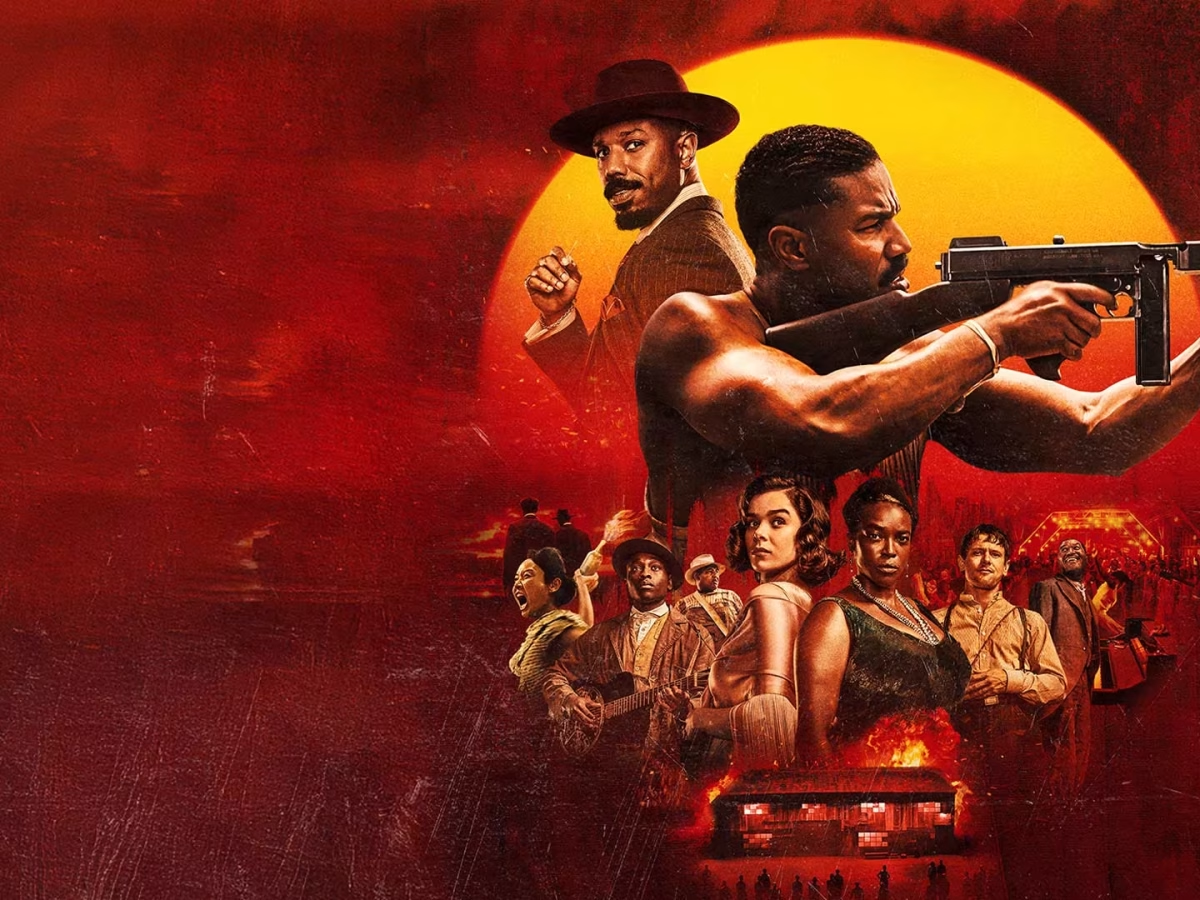
"I see no distinction between a vampire clan and klansmen, between vampires and white supremacists, aside from the fact that the latter invade and destroy our spaces without invitation. The klan and white supremacist logics, too, require the erasure of individual identity and the assimilation into a single white identity—specifically, here, the Southern white identity—and the consumption of the Other for sustenance."

"Given how Black Southern cultural traditions like Hoodoo are demonized, it's imperative to recognize the Black Southern Gothic tradition. It includes literary giants like Toni Morrison and visionary filmmakers like Kasi Lemmons, who weave Black spirituality and distinctly Black Southern experiences into the macabre elements of the larger Southern Gothic canon.
We deserve more horror, especially Black horror, and gothic works that—instead of following the lead of typical Western story conventions—celebrates Black religious traditions and cultural roots outside of Christianity."

"The Belmont-DeVilliers neighborhood, affectionately known as 'The Blocks' is about 35 city blocks just west of central Downtown Pensacola, where many Black families lived and businesses operated during the Jim Crow era. Even today, some of those businesses, like Blue Dot Barbecue, which opened in 1946, remain. But what stands out most to me is the neighborhood clubs and record store being part of the few dozen venues at the time that allowed Black musicians to perform when they were denied access at segregated venues."

As the South goes, so goes the nation
"Nearly a decade into my writing career, as an Atlanta-based journalist, I've become accustomed to national media turning a blind eye to the South. As one of the first journalists to report on Cop City and the Stop Cop City movement, mostly through Atlanta-based outlet Mainline, I spent many hours over the last four years reaching out to bigger outlets, mainstream news reporters, and writing pitch emails, which largely met with silence until the violent police killing of 26-year-old climate activist Tortuguita in January 2023. It showed me what the country thinks of us in the South and "our" problems. In the words of W.E.B. DuBois said, "As the South goes, so goes the nation." Like Cop City, each horrific headline in the news maps onto one that had already occurred in the South and was ignored."

Cicadas rarely sang anymore. Gone were the days of riverside baptisms and backyard fish fries. And no one could remember the stolen recipes. The soul of Cottonwood had been snatched up, and the place—and its people—had been hollowed out. Of course, Lorelai was too young to remember anything but dry, deadening plains, air choked with wildfire smoke, and eroded coastlines.

When Betty said she loved that man,
on that morning,
I wonder where the words fossilized?
If they sheltered in the red wool pattern of his prayer
rug?
That's if she said it before fasting
from her night words.
Maybe she said it before noon prayer?
knowing.
knowing.

"Given the contemporary narratives often spun about the South (typically by those who have no relation to the South), I believe we are in desperate need of remembering stories like this one. The South has such a rich history of working-class struggle (and victory) that seems to get glossed over, or omitted entirely, from the regional history. We need to remember the deep histories of solidarity found in our hometowns and hollers. We need to remember these stories about poor workers standing together, running the racist governor out of town, and setting prisoners free. We need to remember so that we can foster a more complex understanding of who we are as Southerners and reject the cynical, uncritical narratives that cast our communities as a politically homogeneous cultural stain on the country."

"Returning to Mississippi as a 20-something-year-old physician felt like stepping into a narrative that had been shaped by the determination of those who came before me. Black physicians—many of whom were pioneers in the spaces and places they worked in—showed me that true change happens not just through policy but through the daily act of serving communities often overlooked by the larger healthcare system.
As I join those who once mentored me as colleagues in organizations like the Mississippi Medical and Surgical Association (MMSA) and the National Medical Association (NMA), I feel both a deep connection to my past and an urgent drive to contribute to a new chapter. This work isn't about honoring a legacy for legacy's sake—it's about acknowledging the ongoing struggle for health equity and the role we play in transforming that struggle into tangible progress."

Liberal feminism will never liberate us
"Feminism that isn't anti-capitalist, anti-imperialist, and anti-racist, is worthless to those most impacted by these systems and, therefore, doesn't deserve to call itself feminism at all. The fates of a Black single mother in Mississippi working three jobs to make rent, a Palestinian mother in Gaza living under bombs paid for by U.S. tax dollars, and a Congolese girl mining the cobalt that fuels the tech industry are linked by the same global systems of oppression.
This is why feminism must be a radical, internationalist tradition. Fannie Lou Hamer understood that none of us are free until all of us are. That means refusing to be satisfied by optics, slogans, or identity reductionism stripped of substance. It means building a global, intersectional movement that isn't afraid to confront empire, capitalism, and every structure that keeps us in chains."

"I asked for poems that were 'impulsive, dangerous, fugitive, or otherwise subversive (in form, content, or style)' and poems 'about pleasure or struggle, protest, and the future, or the (queer) self.' As if pleasure and struggle do not exist in tandem within our bodies? As if the queer body must not always exist in the future we fabricate by way of performance? As I unlearn the State's enforcement of binaries and segregation, how fitting that I was humbled and checked by poets who offered work that confronts policing and gender subversion, at once. Poems about burial and the tender love of chosen family. Poems that shapeshift while mapping the stars. Poems that are at once on a dance floor in your city, and a protest in mine. Thank you for that defiance, poets. That reminder. That refusal."