
This essay contains spoilers for Sinners (2025)
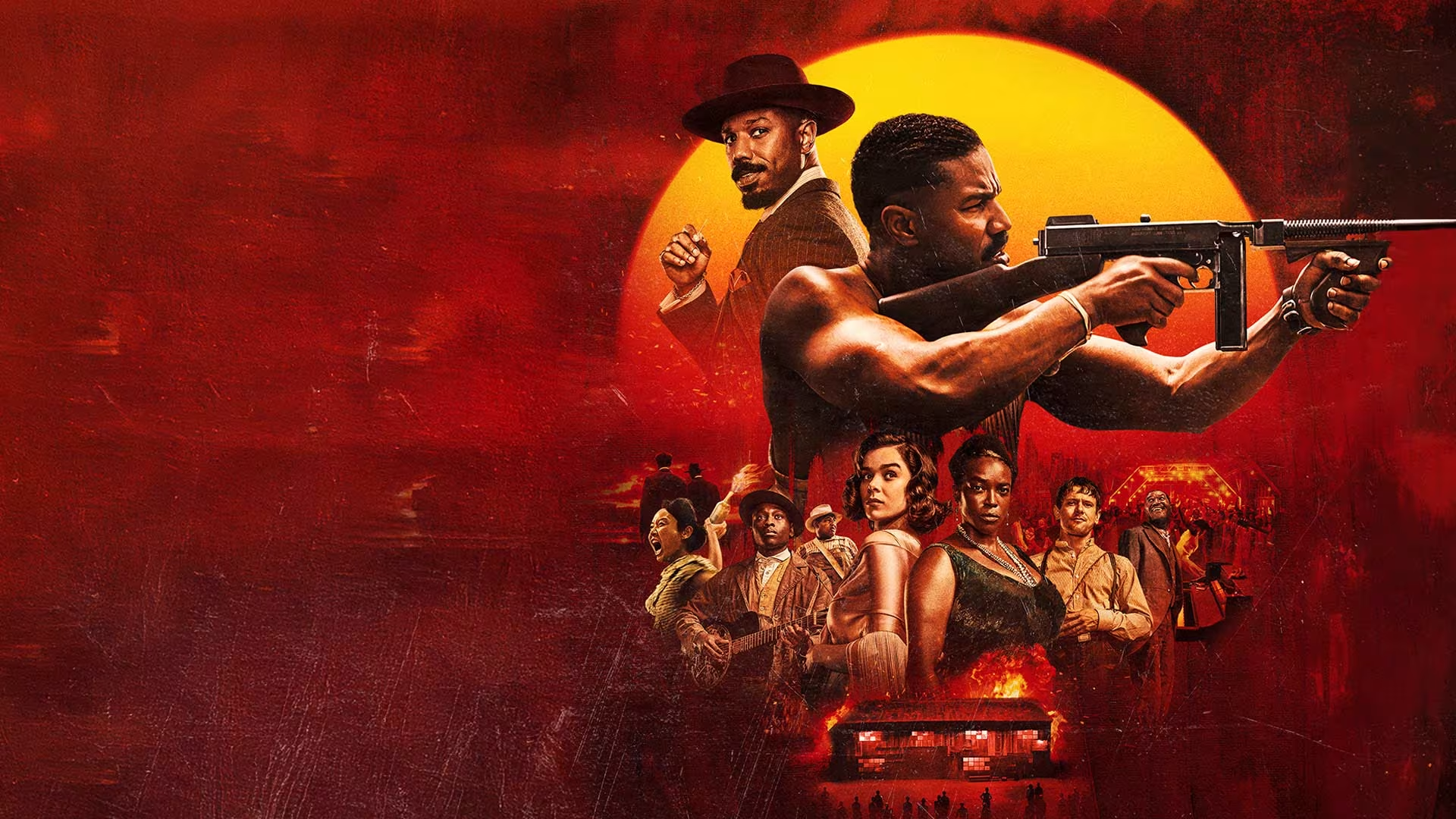
Vampires in the South ain't nothing new. Popular works like Anne Rice's Interview With the Vampire and HBO's True Blood set their vampire stories in the South, using these monsters and surrounding narratives to critique Southern histories, fears, and anxieties. With Sinners (2025), Ryan Coogler follows this tradition of utilizing the vampire to explore Southern identity and politics, delivering a poignant and distinctly Black Southern story about family, religion, autonomy, and the blues.
Mobster twin brothers, Smoke and Stack, return to their hometown of Clarksdale, Mississippi in 1932, having fled Chicago with a bag full of cash and a truck full of Irish beer and Italian wine. It's later revealed that they "robbed both sides" of the Chicago Irish-Italian mob conflict. With their looted riches, the twins open a juke joint in Clarksdale's old sawmill, with aspirations of creating a place where they and their community can feel free. "Look at that sky," Stack tells his brother. "It's a mighty fine day to be free, ain't it? Our own juke joint, for us and by us, just like we always wanted."
"Juke joints are never built; rather, they appropriate previous spaces… The malleability of juke joints developed out of the subversive nature of early blues music itself. During slavery, African Americans were not permitted to gather; in some cases, dancing and singing also were not allowed. Despite these constraints, music played an important role in the development of the African American community. As blues music gained popularity in the Jim Crow South, juke joints became safe places for African Americans to gather without white supervision."
— Juke Joints, The Mississippi Encyclopedia

As veterans of World War I (1914–1918), Smoke and Stack have been "all over this world," fighting overseas for the American cause. Upon their return from the war front, Black WWI veterans were not regarded as heroes by white Americans. Instead, they were largely met with deepened racial discrimination and brutality. In 1917, Mississippi Senator James Vardaman warned that "once a Black soldier was allowed to see himself as an American hero, it would be 'but a short step to the conclusion that his political rights must be respected.'"
The return of Black war veterans became a threat to the order of the Jim Crow South, stirring up white angst about what Black "heroes" might demand. Black soldiers represented the possibility of social mobility for Black folks across the South, and the white supremacist social and economic order of the South required Black folks to remain disenfranchised and exploited laborers at the bottom of the racial hierarchy. White Southerners responded with violent lynch mobs targeting Black veterans, while white-owned businesses intentionally shut them out of many employment opportunities. As a result, many Black veterans fled the South, used their military weapons training to fight back against racist mobs, and sometimes turned to organized crime for survival. It's easy for me to imagine a similar backstory for the Smokestack twins and it affords their search for freedom even more weight.

Though the twins set the stage for the plot that unfolds, the story of Sinners truly belongs to their little cousin, Sammie. The film begins and ends with him, and the story largely centers on his internal conflict. In this way, Sinners is truly a coming-of-age story for Sammie. He's caught between the religious pressures placed on him by his preacher father and his love for the blues, music that his father says is for "drunkards [and] philanderers." Sammie's father urges him to put his guitar down and turn away from sin. "You keep dancin' with the Devil… one day, he's gonna follow you home," he warns as Sammie sets off to join his cousins, guitar in hand, ready to play at their juke joint for the night.
Sammie's musical talents go beyond his mastery of the guitar and his buttery voice. He unknowingly has the ability to summon ancestors and descendants across time and space. The opening voice-over tells us: "There are legends of people born with the gift of making music so true, it can pierce the veil between life and death. Conjuring spirits from the past, and the future… This gift can bring healing to their communities, but it also attracts evil."
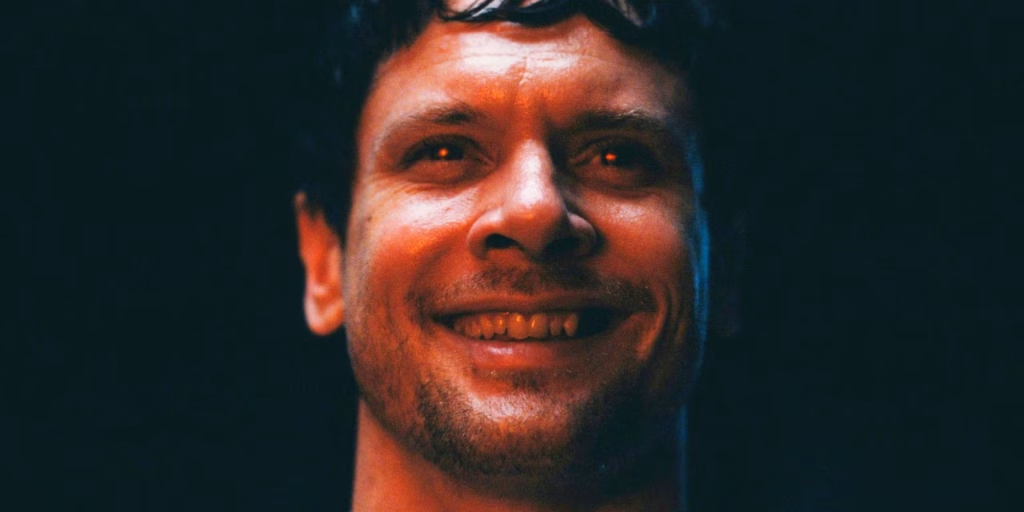
That evil comes in the form of Remmick, a vampire who offers vampirism to the Black juke joint patrons, not as a curse, but as freedom from the indignities of living in the Jim Crow South. "I am your way out. This world already left you for dead. Won't let you build. Won't let you fellowship. We will do just that. Together. Forever." With Remmick looming outside the juke joint, ready to sink his fangs into every last one of them, the group inside must band together to survive the night.
Remmick is revealed to be a vampire of Irish origin—perhaps a nod to Bram Stoker, the Irish author of Dracula (1897), a foundational vampire text that continues to influence pop culture—but his Irishness, and the history of Irishness in this country, is also integral to the story. Remmick preys on Sammie's otherworldly musical abilities, desperate to appropriate these gifts as a means of tending to his own wounds and the stark loneliness inflicted by the British colonial violence that severed his connection to his own Irish culture.
"I want your stories. And I want your songs. And you can have mine, too," he tells Sammie.
Vampirism is an eviction of the self—an erasure of individual identity, an indoctrination into a clan of monsters who must consume the lifeblood of others in order to survive and often lose themselves to their hunger. Through his vampirism, Remmick imposes his own memories and desires onto everyone he acculturates. The juke joint patrons, once made vampires, go from singing and dancing to soulful blues songs of their own culture to singing and dancing to the music of Remmick's Irish culture. He forcefully assimilates others into his own image, as all vampires do. As all colonizers do.

While Remmick's vampirism is the primary threat of the film, the parallel threat is the vampirism of Southern white society itself. This vampirism, however, is not framed as insignificant or ancillary to the threat of Remmick. Instead, it's concurrent. Together, they become comorbidities for the Black characters already constantly prey to the vampiric appetites of Southern white folks and institutions.
"Klan don't exist no more," Hogwood tells the twins during their transaction for the old sawmill. Of course, all three men know this is a lie. Post-WWI, the return of Black war veterans—exacerbated by the 1915 release of The Birth of a Nation and 1920s Prohibition—inspired a KKK resurgence, and their heightened presence was certainly felt throughout the South.
Inspecting the sawmill floors, Stack notices that they've been washed recently. Smoke asks, "What was on 'em?" Hogwood doesn't offer an answer, but the film later provides one. The next morning, Hogwood—the Grand Dragon of the KKK—and a mob of klansmen arrive at the juke joint with the intent to slaughter Smoke, Stack, and anyone else present. The heavy implication is that the klan has done this before, likely many times over, selling the mill to various Black folks and killing them so they can sell it again. As Hogwood's own nephew admits after being turned by Remmick, the sawmill is intended to be a "killin' floor." Blood was spilt on those floors long before Remmick ever descended upon the juke joint.
Southern Vampiric Appetites
I see no distinction between a vampire clan and klansmen, between vampires and white supremacists, aside from the fact that the latter invade and destroy our spaces without invitation. The klan and white supremacist logics, too, require the erasure of individual identity and the assimilation into a single white identity—specifically, here, the Southern white identity—and the consumption of the Other for sustenance.
This consumption is a key feature of white supremacy and colonialism—both figuratively and literally. Hogwood, his fellow klansmen, and Southern white society operate in the same vampiric capacity as Remmick, attempting to siphon everything they possibly can from Black folks to nourish themselves and prolong the eternal life of their fictitious supremacy.
In 1898, the North Carolina daily, News and Observer published a political cartoon depicting a Black vampire overtaking a ballot box with "Negro Rule" branded on its bat-like wings. The monster is gargantuan, towering over its white victims who flee its claws in absolute terror. This drawing, captioned with "The Vampire that Hovers Over North Carolina," captured the racial and political anxieties of Southern whites following Reconstruction. So much so that the News and Observer ran a strikingly similar drawing under the name "Negro Rule" in 1900.
White folks afraid of Black autonomy—that "freedom" Smoke and Stack were searching for—project their own vampiric intentions onto us, constructing the "Negro Rule" they so deeply fear as a vampiric monstrosity. This fictional monstrosity, in turn, becomes a convenient way to further disenfranchise Black folks.
"By 1900, only one out of 10 eligible Black persons remained on the voter rolls… That same year, the state Democratic Party instituted the white primary barring Black voters from participation."
—After Reconstruction, The Atlanta History Center


Southern white society's fear of Black autonomy hasn't dissipated, especially political autonomy. This month, the Supreme Court heard oral arguments in Louisiana v Callais, a case that threatens Section 2 of the Voting Rights Act and the last remaining protection against racial discrimination in redistricting since the Supreme Court first gutted the Voting Rights Act in 2013.
For several years now, Louisiana Republicans have strived to further silence Black voters by redrawing the congressional map in a state historically rife with anti-Black voter suppression. Initially, Louisiana redrew the map encompassing six House districts with only "one majority-Black district and five majority-White districts, even though African Americans make up nearly one-third of Louisiana's population."
When a federal judge ruled that the map diminished Black voting strength, a violation of Section 2 of the Voting Rights Act, the state went back to the drawing board and returned with two majority-Black congressional districts. The Supreme Court must now determine whether this redrawing of districts is evidence of gerrymandering and, therefore, violates the Constitution. It's a decision that will have far-reaching implications for Black voters throughout the rest of the South and, eventually, the rest of the nation.
I see no distinction between a vampire clan and klansmen, between vampires and white supremacists, aside from the fact that the latter invade and destroy our spaces without invitation.
Southern states like Georgia, Florida, Alabama, and, of course, Mississippi deploy voter suppression tactics that disproportionately impact the Black electorate. In 2024, courts in Texas and South Carolina, respectively, decided in favor of Republicans when they were challenged on voter suppression tactics that distinctly targeted Black and Latine voters. North Carolina is currently embroiled in a lawsuit challenging a recently redrawn congressional map that many see as a blatant attempt to dilute the power of Black voters.
The disfranchisement of Black voters has always been a primary goal of Southern white society, as they fear Black political autonomy, and voter suppression has always been one violent means of doing so. It's yet another form of vampirism, an attempt to take everything they can from Black folks and impose their will on us to sustain their power.
The North Carolina News and Observer cartoons of Black vampires at the ballot box add another layer to Sinners for me, especially as a Black North Carolinian. The idea of Black vampires in the Jim Crow South, or even the contemporary South, is appealing. I found myself intrigued by Remmick's offer on my first watch. My appetite piqued at the thought of Black Mississippians in the 1930s becoming a true threat to the white Southerners invested in their consumption. What if the Black citizens of Clarksdale, or any other Southern city, could become the vampiric monstrosities white folks accused them, us, of being? Wouldn't that be a delicious turning of the tables?
But the sacrifice it would require—turning over Sammie, relinquishing a hold on Black Southern songs, stories, culture, life, and identity to Remmick—would ultimately be too high of a price to pay. As Coogler himself says, the vampire "represents an escape and also a trap."
The horrors of Southern history cannot be divorced from the ways vampirism shows up in the South, both in fiction and reality. From the voter suppression discussed here, to the (mis)appropriation of Black Southern culture and AAVE, to economic exploitation through "racially predatory governance and resource extraction," the expansion of AI data centers and other forms of environmental racism in the South.
The scheme to extract from us—our labor, our autonomy, our health, our energy—to sustain a deeply inequitable society is a persistent one. In the South, Black folks are always surviving vampires.
