

Decaying plantation houses, spectral forms in haunted dwellings, the past creeping into the present, and dark family secrets. Curses, mysteries, and hauntings. Taboo desires, religious fanaticism, and cultish devotion. Madness, paranoia, and profound despair. These motifs help define the Southern Gothic genre—narrative explorations of the macabre, the unsettling, and the horrific in the American South. Often, they examine how personal ghosts are connected with and informed by larger Southern legacies.
This Southern Gothic tradition arose in response to romanticized narratives and idyllic imagery of pastoral Southern scenes and society, particularly post-Civil War. Canonical Southern Gothic greats like Flannery O'Connor, William Faulkner, and Tennessee Williams chose to write against those popular, comfortable narratives, writing instead to expose the ugliness beneath the veneer of Southern politeness and pride, using their stories to shine a harsh, unflinching light on social inequities, atrocities, and hypocrisies. Inspired by elements of British and American Gothic traditions, Southern Gothic works set their tales of dread in the American South with intention, exploring how racism, patriarchy, nationalism, and more are still deeply embedded in Southern culture, institutions, and homes.
"Though fantastical elements like hauntings don't have to exist in Southern gothic, there is often a feeling of not-quite-rightness. It's the ugliness simmering beneath pretty surfaces that is a hallmark of this genre. In many cases, the characters are much worse than any terrors that come crawling from a cemetery."
—Southern Gothic: Shadows, Superstition, and the Supernatural
Southern Gothic texts have evolved since the dawn of the tradition, and they will continue to evolve to engage with the conditions of the time. I envision future Southern Gothic texts grappling with a host of phenomena and social issues, exploring how they impact the South: AI data centers in Black Southern communities, environmental pollution, and post-COVID onset health inequities; climate change injustices, disaster capitalism, and the failures of disaster response and recovery; increasing poverty rates and gentrification exacerbating food apartheid, housing inaccessibility, and infrastructure crises; racial capitalism and crypto-cultism; mass surveillance and censorship; AI and techno-fascism, the continued alignment of technology industries with the nation-state; detention centers and post-Cop City advanced militarized policing to quell resistance. The possibilities are, unfortunately, abundant.
Another significant element in the Southern Gothic tradition is the presence of Southern folk magic and its practitioners, particularly Hoodoo and conjure folk. Hoodoo—often also referred to as roots, rootwork, or conjure—is a set of beliefs and traditions taken from various African spiritualities and developed by enslaved folks in the South, with practices centering on ancestral veneration and justice.
Like most non-mainstream religions and denominations, Hoodoo is sorely misunderstood and often demonized outside of the intimate communities that seriously engage in and study the practice. Much of Western horror and American Gothic is thinly-veiled Christian propaganda. In these stories, the religions, beliefs, cultures, and traditions of Black, Indigenous, and people of color are often framed as demonic, immoral, irrational terrors against (mainly, but not always) white protagonists. Along with Hoodoo, "Voodoo," Native American burial grounds and rituals, witch doctors, Shamans, brujeria, g*psy curses, and more have long been mainstays in Western horror and American Gothic texts. After decades of indoctrination and subliminal messaging through media and society at large, uncritical audiences simply accept their "evil" nature as truth.
Christian horror, on the other hand, plays like a superhero narrative. The Christians arrive to save the possessed from demonic possession or infestation, armed with the Bible, crucifixes, holy water, and prayers. More often than not, they prevail over evil with the Christian god and his angels on their side. The Exorcist is perhaps the most famous example of this, and The Conjuring franchise perhaps the most egregious.
Given how Black Southern cultural traditions like Hoodoo are demonized, it's imperative to recognize the Black Southern Gothic tradition. It includes literary giants like Toni Morrison and visionary filmmakers like Kasi Lemmons, who weave Black spirituality and distinctly Black Southern experiences into the macabre elements of the larger Southern Gothic canon.
We deserve more horror, especially Black horror, and gothic works that—instead of following the lead of typical Western story conventions—celebrates Black religious traditions and cultural roots outside of Christianity. Ryan Coogler's Sinners (2025) is one such film, allowing Hoodoo to function as a weapon against evil in stark contrast to how these practices are often portrayed. From the haint blue peppered throughout the film, to Annie's role as the wise protector with necessary knowledge and power, to the mojo bag Smoke keeps close to his heart—Hoodoo is revered and celebrated in Sinners. It's an integral part of the plot and story.
But, of course, Sinners was accused of being "demonic" and "dark spirited" and "evil" upon its release for daring to uplift Hoodoo and depict Christianity as anything other than heroic. Christian music artist Lecrae called it "anti-Chrisitan propaganda," declaring that Coogler is "fighting evil with evil" in the film. Many folks—Black folks included, sadly—continue to regard Hoodoo and anything other than traditional Christianity as "evil."
In honor of the season, I offer a non-exhaustive list of Southern Gothic films, TV series, novels, and video games—some more well-known than others and in no particular order—and, as October is Hoodoo Heritage Month, many of the works listed here feature Hoodoo. May we continue in the Southern Gothic tradition, using art to acknowledge the past as revenant, embrace folk magic, and contend with the systemic issues that impact the South, whether others see it as "evil" or not.


Beloved (1987)
Toni Morrison's Pulitzer-winning novel, inspired by the real-life story of Margaret Garner, is a Southern Gothic classic, adapted to film in 1998. Though much of the novel is set in Ohio after Sethe flees the South, the nexus of the story is what transpires at the Sweet Home plantation in Kentucky. Family secrets, a visceral haunting, and the persistence of the past play significant roles in this story that refuses to look away from distinctly Southern horrors.


The Color Purple (1982)
Another Pulitzer Prize winner, Alice Walker's epistolary novel follows Celie, a girl living in rural Georgia in the early 1900s. Told through Celie's letters, the story includes elements of misogynoir and patriarchy, family secrets and abuse, and antiBlack violence, but also resilience and community. It has been adapted to film twice (1985 and 2023) as well as a Tony Award-winning Broadway musical.


Their Eyes Were Watching God (1937)
Zora Neale Hurston's most popular work is set in Florida during the early 20th century. Janie Crawford returns home after a scandalous exit one year before and tells her life story to an inquisitive friend—a forced marriage, a sexual awakening, a devastating heartbreak, and more. In the Southern Gothic tradition, it explores grief, loneliness, domestic abuse, violent patriarchal logics, and the stark racism of the time.

Mama Day (1988)
In Gloria Naylor's third novel, Cocoa and her lover George visit Cocoa's family on a coastal island near the Georgia-South Carolina border. There, Cocoa's relative, Mama Day, must use rootwork to ward off an evil placed on Cocoa's life in the midst of a rampaging hurricane. Naylor uses folk magic and mysticism to put forth a story about a family marked by trauma.

Corregidora (1975)
This novel by Gayl Jones is set in Kentucky during the late 1940s, and delves into the psyche and family history of blues singer Ursa Corregidora. Her life is defined by loneliness, despair, and grief, as she is tormented by the ghosts of a Brazilian plantation where her foremothers were held. The story covers domestic abuse, generational trauma, reproductive and sexual violence, and traumas visited upon the minds, bodies, and wombs of Black women.
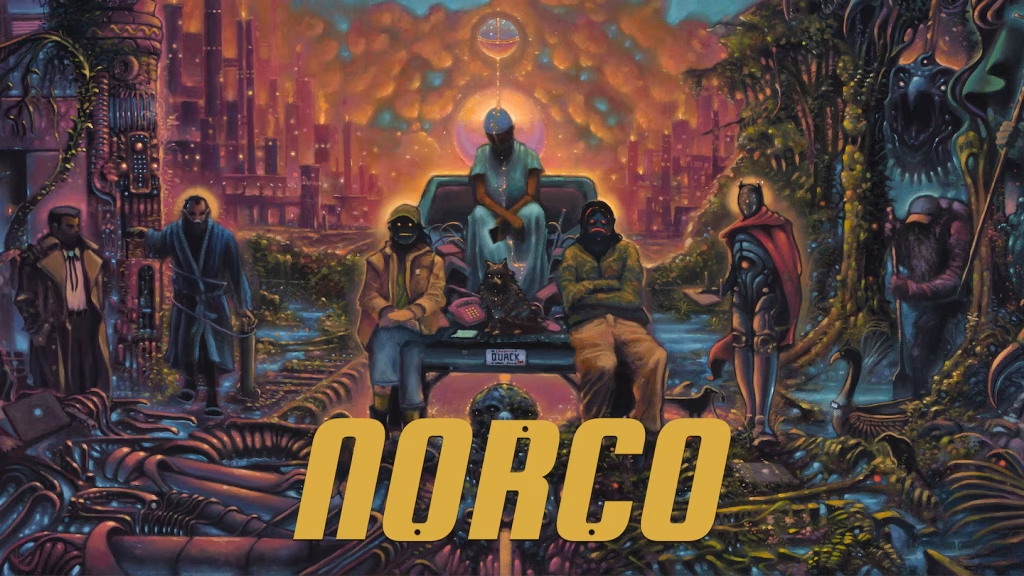
Norco (2022)
This dialogue-focused, point-and-click adventure game is set in the industrial swamplands of a futuristic Norco, Louisiana. You play as Kay, returning home after the death of her estranged mother. Soon after, Kay must search for her missing brother, ultimately becoming embroiled in the mystery surrounding her mother's investigations involving Shield Gulf South, a transnational oil conglomerate that owns half the town and poisons the community. The opening text tells us, "Shield hid the stars behind halogen and flame projected onto the sky every night. There was no such thing as silence… The refinery exhaled an endless sigh." It's a beautiful, pixelated condemnation of environmental destruction, climate crisis, abandonment, and corporate cruelty in the South's Cancer Alley.

When the Reckoning Comes (2021)
LaTanya McQueen's novel follows Mira as she returns home for a wedding at a plantation-turned-resort. There, she confronts the plantation's brutal history and encounters vengeful ghosts of the enslaved, and the story unfolds into an exploration of generational trauma and revisionist histories.

Model Home (2024)
In this novel by Rivers Solomon, three adult siblings return to the affluent Dallas suburb they grew up in following the death of their parents. The siblings, who suspect that their childhood home is haunted, believe the house may have killed them. The story centers on racial trauma, family dysfunction and secrets, and domestic upheaval.

Psychopomp & Circumstance (2025)
This new Southern Gothic historical fantasy by Eden Royce follows Phee, a young woman living in South Carolina during the Reconstruction era. When her Aunt Cleo passes away, Phee takes on the responsibility of planning the homegoing service. She arrives at Aunt Cleo's home to find it deeply unsettling, and is soon plagued by mysterious visions and haunting shadows. The story engages with family secrets, patriarchal expectations, and the struggle for autonomy. Royce says, "Readers can expect an exploration of grief and duty that takes a sheltered, well-bred, free young Black woman on a journey from one showy magical city to another."


The Walking Dead (2003–2019)
Robert Kirkman's comic series has been adapted into an array of TV shows and video games. The post-apocalyptic series follows a group of survivors in Kentucky in the midst of zombie contagion. However, the AMC original series sets the story in rural Georgia. Along with the roaming and insatiable undead, referred to as "walkers," there are decaying social structures, architecture, and landscapes. A grotesque sense of rot and despair is inescapable as the group travels through various settings in search of sanctuary: the CDC, the farm, the prison, the slaughterhouse. As the series progresses, the survivors migrate to other regions of the country, but that sense of Southern Gothicism endures.


Interview With the Vampire (1976)
Vampire Louis de Pointe du Lac speaks with a young reporter, recounting the story of how he was made a vampire by Lestat de Lioncourt in 18th-century New Orleans. After his turning, he and Lestat begin a tumultuous relationship. The novel deals with themes of guilt, decay, religion, and the oppressive social landscape of New Orleans. Rice's work includes queer elements, but Louis and Lestat's queer relationship is merely hinted at in the 1994 film adaptation. The bolder AMC series portrays their relationship as unambiguously queer—though no less tumultuous— casts Louis as a Black man from an affluent family, and transports the story to 1910s New Orleans.

True Detective, Season One (2014)
The inaugural season of the anthology series, written by Nic Pizzolatto, follows homicide detectives and reluctant partners Rustin Cohle and Martin Hart in rural Louisiana. Their story spans 17 years, beginning with the discovery of a murdered sex worker in 1995. The case is shrouded in mystery and mysticism, ultimately delving into ritualistic displays connected with cult and occult activity. Rust's synaesthesia and musings on circular temporality also add a layer of surrealism and hint at the supernatural in the midst of the macabre tone and bleak landscape.

Sinners (2025)
Ryan Coogler's first original film follows a Black community in Clarksdale, Mississippi on the night they encounter a vampiric intruder in 1932. Hoodoo, religious tensions, and the transformative power of the blues are woven together to achieve a truly unique experience that does not shy away from the realities of Jim Crow.

South of Midnight (2025)
This stop-motion animation style game draws heavily on Southern folklore and mythology, incorporating elements of Hoodoo beliefs and practices into its world-building. Hazel Flood must go searching for her mother after their trailer is washed away during a hurricane with her mother inside. Along her journey through the swamplands of Louisiana, she encounters haints, the specters of runaway slaves, family secrets, and figures from various Southern folktales.

The Princess and the Frog (2009)
In 1920s New Orleans, Tiana meets Prince Naveen, who is transformed into a frog by a voodoo witch doctor, Dr. Facilier. After becoming a frog herself, Tiana and the prince go on a quest to find a way to become human again, battling the cunning Dr. Facilier and his shadow demons along the way.

Daughters of the Dust (1991)
Julie Dash's timeless epic—or, if you prefer, anti-epic—is the first feature film directed by a Black woman to receive theatrical distribution. Set in South Carolina in 1902, at the start of the Great Migration, Dash's debut uses magical realism to tell the story of three generations of Gullah women in the Peazant family who "must decide whether to leave their Sea Island home for the promise of a 'better' life up North or stay rooted in the land and traditions that have defined them."

Eve's Bayou (1997)
Kasi Lemmons' Southern Gothic family drama has become a cult classic among fans of the genre. Growing up in a Creole Louisiana community in the 1960s, 10 year old Eve Batiste has a stark awakening when she learns of her father's infidelity. Eve seeks the counsel of her Aunt Mozelle, a Hoodoo practitioner, and the summer cascades into a chaotic series of events. It's a story of family secrets, budding sexuality, domestic strife, folk magic, clairvoyance, and dead husbands.

The Skeleton Key (2005)
Hospice nurse Caroline Ellis finds herself entangled in a mystery when she begins working in the unsettling home of elderly couple, Violet and Ben Devereaux, in the Louisiana bayous. She descends into a world of conjure work, secrets, deceit, and the ugly history of the home.

The Reformatory (2023)
Tananarive Due blends historical fiction with horror in this award-winning novel. Twelve-year-old Robbie Stephens Jr. is sent to a reformatory in 1950s Florida, an institution inspired by the real-life Dozier School for Boys. There, Robbie must use his gift of sight to follow ghosts and investigate the mystery of boys gone missing. It's a coming-of-age tale in which the past continues to haunt the present.

This Cursed House (2024)
Jemma Barker takes a job with a mysterious family in New Orleans during the 1960s. Soon, she learns of their family curse and hopes she can use her ability to see spirits to help release them. This novel by Del Sandeen is an examination of identity, self loathing, and the lingering effects of racial trauma.

Sugar Hill (1974)
In 1970s Houston, Diana "Sugar" Hill embarks on a revenge mission after her lover is murdered by a local mob boss and his goons. She seeks the help of voodoo queen Mama Maitresse, who summons Baron Samedi, Lwa of the dead. Ultimately, they raise an army of zombies animated from the preserved corpses of slaves. Along with vengeance, this blaxploitation horror classic explores Black empowerment, racism, and misogynoir.

I'll Make a Spectacle of You (2025)
The forthcoming debut novel by Beatrice Winifred Iker takes place at Bricksbury University, an HBCU in Jonesborough, Tennessee, blurring the lines between reality and folkloric legends. Grad student Zora Robinson is excited to begin her program in Appalachian Studies, and her thesis advisor suggests she focus her research on local folklore about a beast in the woods near campus. Zora gets wrapped up in a conspiracy involving a secret society and fights through mysterious visions on her journey to discover the truth behind the history of the university. In an interview about her work, Iker notes that setting her Southern Gothic tale in one of the oldest towns in Appalachia gives her the opportunity to "explore the natural processes of decay and decomposition. One of my favorite aspects of the Southern gothic genre is how it intertwines organic decay with themes of societal and moral decline."